
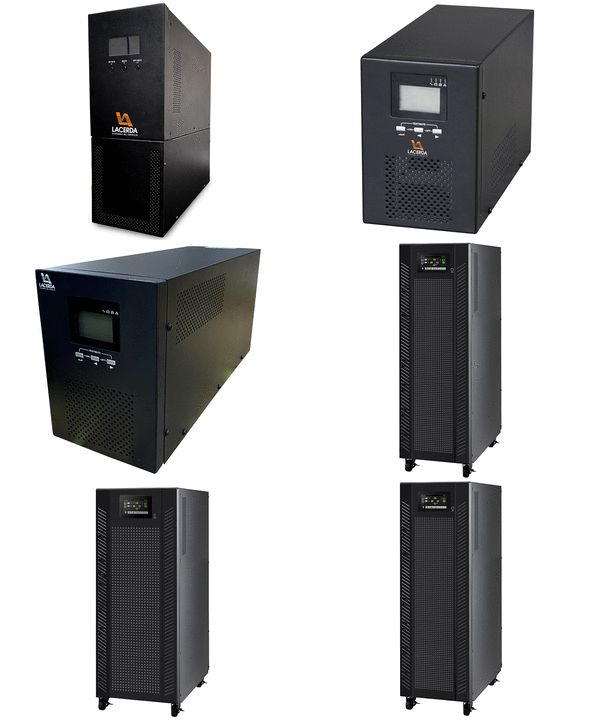


Cost-Effective APF/UPS System with Seamless Mode Transfer
Woo-Cheol Lee
Abstract – In this paper, the development of a cost-effective active power filter/uninterruptible power
supply (APF/UPS) system with seamless mode transfer is described. The proposed scheme employs a
pulse-width-modulation (PWM) voltage-source inverter and has two operational modes. First, when
the source voltage is normal, the system operates as an APF, which compensates for the harmonics and
power factor while boosting the DC-link voltage to be ready for the disturbance, without an additional
DC charging circuit. A simple algorithm to detect the load current harmonics is also proposed. Second,
when the source voltage is out of the normal range (owing to sag, swell, or outage), it operates a UPS,
which controls the output voltage constantly by discharging the DC-link capacitor. Furthermore, a
seamless transfer method for the single-phase inverter between the APF mode and the UPS mode is
also proposed, in which an IGBT switch with diodes is used as a static bypass switch. Dissimilar to a
conventional SCR switch, the IGBT switch can implement a seamless mode transfer. During the UPS
operation, when the source voltage returns to the normal range, the system operates as an APF. The
proposed system has good transient and steady-state response characteristics. The APF, charging
circuit, and UPS systems are implemented in one inverter system. Finally, the validity of the proposed
scheme is investigated with simulated and experimental results for a prototype APF/UPS system rated
at 3 kVA.
Keywords: APF, UPS, Voltage sag, Outages, Compensation, Harmonics, Seamless mode transfer.
LINK
http://www.jeet.or.kr/ltkPSWeb/pub/pubfpfile.aspx?ppseq=1152
No Blog Eletrônica de Potência você encontrará informações sobre teses,artigos,seminarios,congressos,tecnologias,cursos,sobre eletrônica potência. “TEMOS O DESTINO QUE MERECEMOS. O NOSSO DESTINO ESTA DE ACORDO COM OS NOSSOS MERITOS” ALBERT EINSTEIN. Imagination is more important than knowledge, for knowledge is limited while imagination embraces the entire world. EL FUTURO SE CONSTRUYE HOY,EL SUCESSO NO ES FRUTO DE LA CASUALIDAD,SE HUMILDE ,APRENDE SIEMPRE CADA DIA.
AUTOR DO BLOG ENG.ARMANDO CAVERO MIRANDA SÃO PAULO BRASIL
“GRAÇAS A DEUS PELA VIDA,PELA MINHA FAMÍLIA,PELO TRABALHO.PELO PÃO DE CADA DIA,POR NOS PROTEGER DO MAL”
“SE SEUS PROJETOS FOREM PARA UM ANO,SEMEIE O GRÂO.SE FOREM PARA DEZ ANOS,PLANTE UMA ÁRVORE.SE FOREM PARA CEM ANOS,EDUQUE O POVO”

https://picasion.com/


quinta-feira, 16 de junho de 2016
A Cost-Effective, Single-Phase Line-Interactive UPS System that Eliminates Inrush Current Phenomenon for Transformer-Coupled Loads Byung-il Kwon Dept. of Electronic Systems Engineering, Hanyang University, South Korea
A Cost-Effective, Single-Phase Line-Interactive UPS System that Eliminates Inrush Current Phenomenon for Transformer-Coupled Loads
Byung-il Kwon Syed Sabir Hussain Bukhari*, Shahid Atiq*, Thomas A. Lipo** and Byung-il Kwon†
Abstract – Sudden voltage drops and outages frequently disturb the operation of sensitive loads for domestic, commercial, and industrial use. In some cases, these events may even impair the functioning of relevant equipment. To maintain power under such conditions, a UPS system is usually installed. Once a disturbance happens at the grid side, the line-interactive UPS system takes over the load to prevent an interruption. But, due to magnetic saturation of the transformer, a significant inrush current may occur for the transformer-coupled loads during this transition. The generation of such transient currents may in turn decrease the line voltage and activates over-current protecting devices of the system. In this work, a cost-effective, line-interactive UPS system is proposed that eliminates the inrush current phenomenon associated with transformer-coupled loads. The strategy was implemented by connecting a standard current-regulated voltage source inverter (CRVSI) to the secondary winding of the load transformer. During any transient condition at the grid side, the load current is monitored and regulated to achieve either seamless compensation of the load current or complete transferal of load from grid to the inverter. Experimental results were obtained for a prototype under all possible operating conditions so as to validate the performance of the proposed topology.
Keywords: UPS systems, Single-phase line-interactive, Inrush current elimination
LINK ORIGINAL
http://www.jeet.or.kr/ltkPSWeb/pub/pubfpfile.aspx?ppseq=1491
High Step-up DC-DC Converter by Switched Inductor and Voltage Multiplier Cell for Automotive Applications-Divya Navamani. J , Vijayakumar. K, Jegatheeesan. R and Lavanya. A-Dept. of Electrical and Electronic Engineering, SRM University, India
High Step-up DC-DC Converter by Switched Inductor and Voltage Multiplier Cell for Automotive Applications
Divya Navamani. J † , Vijayakumar. K*, Jegatheeesan. R* and Lavanya. A*
Abstract - This paper elaborates two novel proposed topologies (type-I and type-II) of the high step- up DC-DC converter using switched inductor and voltage multiplier cell. The advantages of these proposed topologies are the less voltage stress on semiconductor devices, low device count, high power conversion efficiency, high switch utilization factor and high diode utilization factor. We analyze the Type-I and Type-II topologies operating principle and mathematical analysis in detail in continuous conduction mode. High-intensity discharge lamp for the automotive application can use the derived topologies. The proposed converters give better performance when compared to the existing types. Also, it is found that the proposed type-II converter has relatively higher voltage gain compared to the type-I converter. A 40 W, 12 V input voltage and 72 V output voltage has developed for the type-II converter and the performances are validated.
Keywords: High step-up, Switched inductor, Voltage multiplier, Steady state analysis, CCM, DCM.
LINK ORIGINAL EN LA WEB
http://www.jeet.or.kr/LTKPSWeb/uploadfiles/be/201605/130520161455380160000.pdf
Design of LED Luminaire for Parking Garage - Hao Cui and Si-Hyun Park- Dept.of Electronic Engineering, Yeungnam University, South Korea.
Design of LED Luminaire for Parking Garage Hao Cui* and Si-Hyun Park†
Abstract – This study aims to design a zonal lumen for parking garage LED lightings of a slim appearance and 20 W/2,000 lm capacity and to fabricate a lighting luminaire accordingly. The frame is of a one-dimensional bar type with a reverse V-shaped section, with LED chips arranged along both sides. To maximize the 60° to 80° zonal lumen, the geometric structure was designed with the apex of the reverse V-shaped section at 40° and both sides at 70°. As for the LED light source, focusing lenses with narrower full-width half-maximum (FWHM) in luminous intensity were used. A ray-tracing simulation method was utilized for the zonal lumen simulation of the given structure. An actual hardware of luminaire based on the simulation results was fabricated and characterized. The suggested model is meant to develop LED lightings with a proper level of zonal lumen required in parking garages.
Keywords: LED luminaires, Parking garage, Zonal lumen
LINK FULL PAPER :
http://www.jeet.or.kr/LTKPSWeb/uploadfiles/be/201603/040320161657037972500.pdf
A 3 kW Bidirectional DC-DC Converter for Electric Vehicles Arsalan Ansari, Puyang Cheng and Hee-Jun Kim Dept. of Electronic Systems Engineering, Hanyang University,South Korea.
Abstract – A bidirectional DC-DC converter (BDC) is an indispensable electrical unit for the electric
vehicles (EVs). High efficiency, high power density, isolation, light weight and reliability are all
essential requirements for BDC. In this paper, a 3 kW BDC for the battery charger of EVs is proposed.
The proposed converter consists of a half-bridge structure on the primary side and an isolation
transformer and a synchronous rectifier structure on the secondary side. With this topology, minimum
number of switching devices are required for bidirectional power flow between the two dc buses of
EVs. The easy implementation of the synchronous rectification gives advantages in terms of
efficiency, cost and flexibility. The proposed BDC achieves high efficiency when operating in both
modes (step-up and step-down). A 3 kW prototype is implemented to verify theoretical analysis
and the performance of the proposed converter.
LINK ORIGINAL
http://www.jeet.or.kr/ltkPSWeb/pub/pubfpfile.aspx?ppseq=1515
LINK ORIGINAL
http://www.jeet.or.kr/ltkPSWeb/pub/pubfpfile.aspx?ppseq=1515
Assinar:
Comentários (Atom)


