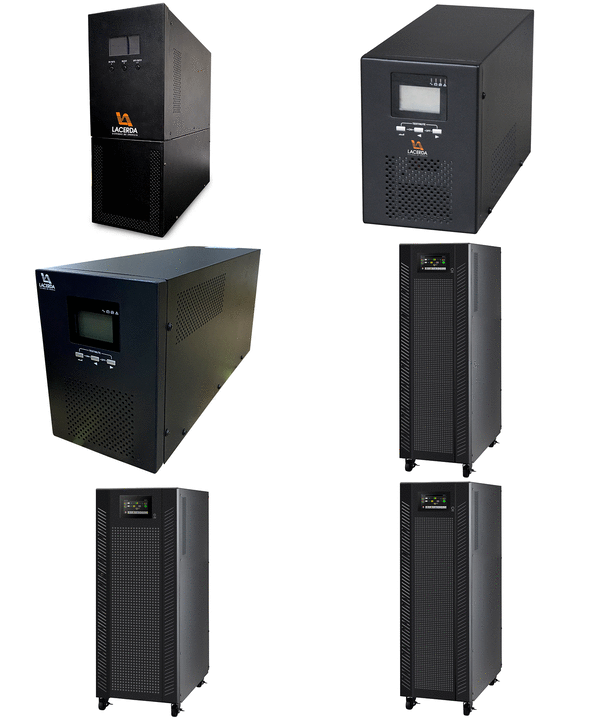
Fire Hazards of UPS Components and Reliability of UPS-ENG. ARMANDO CAVERO MIRANDA
UPS Capacitor Failure and Explosion Case
ABSTRACT
UPS (Uninterruptible Power Supply) is a backup power source for computer and communication equipment for data storage and
processing, and for emergency equipment such as firefighting equipment, CCTV, and elevators to ensure safety in emergency situations.
It is being used as a power source, and its demand and necessity are increasing due to the 4th industrial revolution and strengthening of safety
regulations, and it is being used in various fields such as general businesses, production facilities, hospitals, and military facilities.
Domestic and international standards and technical criteria and related research have been conducted to
prevent UPS supply interruptions and fire accidents, but UPS-related accidents continue to occur. In general,
Most UPSs installed in industrial facilities have large equipment and battery capacity, so they are often neglected
after initial installation except for a simple visual inspection, despite the high risk of fire accidents.
There are frequent cases where it is difficult to secure reliability or it leads to fire accidents.
Therefore, this study quantitatively analyzed risk factors for UPS and derived risks.
The risk scenarios were further divided into the risk of overheating and the risk of arcing and sparking, and the assessment was
conducted. As a result, in terms of supply reliability, AC and DC components among UPS components were evaluated.
It was found that the failure probability was high in the order of Capacitors, Battery Charger, Battery
Module, Inverter, and Rectifier, and the detailed failure modes were Short, Open, and Seal of the Capacitor.
In the case of Failure, the probability of failure was high in the order of Short, Intermittent output, and Degraded output
in the Battery Charger, and in the case of Capacitance Incorrect, Loose, and Contaminated in the Battery Module.
And to prevent the risk of overheating among fire hazards, overheating of equipment due to battery
cell failure, AC and DC capacitor overheating, air conditioner failure, and cooling fan failure
It was found that it is important to manage the back, and to prevent arcs and sparks inside the UPS, it is necessary to manage the
temperature and humidity inside the UPS room, such as fan and air conditioner failure, and to check the inside of the panel.
It was confirmed that facility temperature control and ventilation facility management through maintenance of the cooling fan
are important.
1) Suggestions for AC and DC capacitors
Capacitors are electrical devices that store and release electrical energy. They are manufactured
in various sizes, from as small as a fingernail to as large as a beverage can, depending on their
rated capacity. Generally, A capacitor, housed in an aluminum or chrome-plated cylinder,
contains a pair of conductive surfaces (often metal plates or electrodes) that are connected by a
third element called a dielectric medium.
Separated and insulated. The role of DC capacitor in UPS can be defined as "supply voltage
filtering", and when there is a change in input voltage, the capacitor attenuates the voltage change.
It helps to maintain a constant voltage level by removing the peak. AC capacitors are
mainly found in the input and output filters of UPS, and smooth out the input transients.
It reduces harmonic distortion of the utility input to the UPS and is directly connected to the
critical load output, helping to control the waveform shape of the UPS output voltage.
Materials such as paper, aluminum foil, and electrolyte inside these capacitors age over
time and begin to decompose physically and chemically, reducing the electrostatic capacity.
The capacitor may lose its function and may fail. Also, adverse operating conditions such as
overcurrent, excessive work, and excessive heat may shorten the life of the capacitor.
Factors that can shorten the life of a capacitor include:
• Excessive current: Capacitors may be destroyed if exposed to regular and continuous overcurrent conditions exceeding their rating.
• Excessive duty: If abnormal voltage noise or frequent transients must be filtered, the
capacitors will fail more often and need to be replaced more often.
• Excessive heat: Excessive heat inside or around a capacitor can cause the liquid inside the
capacitor to evaporate and build up pressure, which can lead to failure. To prevent this:
is to operate the UPS within its rated capacity in a clean and cool environment.
Among the failure modes of a capacitor, "Open" occurs when the capacitor cannot conduct
current into or out of the plates and thus cannot function as a capacitor. Open failure
If this occurs, it may affect the supply reliability of the UPS and increase the stress level of
the UPS.
Among the failure modes of a capacitor, "Short" occurs when a conductive path is formed between the two terminals inside.
When the insulation resistance is significantly reduced, the capacitor cannot conduct a large current.
It can also generate Joule heat, which can cause a fire in the capacitor or leakage of the
internal dielectric, and in severe cases, an explosion, and the electrolyte is conductive.
Therefore, the leaked electrolyte can form a conductive path. Also, many
electrolytic capacitors are corrosive and can affect other components of the UPS.
They are often designed with a mark on one end to allow the electrolyte to leak smoothly rather
than suddenly bursting and spreading over a large area.
To prevent such breakdowns, fires and explosions, the following precautions should be taken regarding UPS capacitors:
I would like to suggest two improvements.
① Install insulation and protective cover on the upper terminal of the capacitor
Insulating rubber is installed between the upper terminals to prevent cross-contact and conductive path formation between the terminals.
To prevent a short circuit accident, a protective cover is installed on the top of the capacitor to prevent dust, moisture, and foreign
substances from entering, and in the event of a capacitor explosion, it is also installed to prevent the surroundings from being damaged.
To prevent the quality from flying away and causing damage, a protective cover is installed on the top. Fig. A and
Fig. B show examples of the application of these improvements, respectively
Photo A Installing insulating rubber between the upper terminals of the UPS capacitor
Photo B Installing the UPS Capacitor Upper Terminal Protection Cover
② Installing the capacitor temperature sensor
A temperature sensor is installed to check for abnormal overheating of individual capacitors and capacitor banks, and a signal is sent to the UPS input contact to monitor temperature saturation in real time.
If the temperature of the capacitor rises rapidly, a system is built to isolate the UPS and switch to
the bypass. Fig. C and Fig. D show the corresponding improvements, respectively.
Photo C UPS Capacitor Temperature Sensor Installation
Fig. D UPS Capacitor Temperature Sensor Signal Connection Diagram
2) Suggestions for Battery Modules
The most commonly used lead-acid battery in UPS today is VRLA (Valve-Regulated Lead-Acid).
Acid) type is the most economical and also has high reliability. It has a design life of 5 to 10
years depending on the installation and usage environment, and is dry and average.
They work best in environments with temperatures between 20 and 25°C. However, lead-acid batteries can malfunction if they are not used and replaced in the proper environment and are exposed to frequent charging and discharging.
The most common and likely failures that can occur are:
• Discharging an unused battery: A battery left unused will also have a reduced lifespan. To
extend the battery's shelf life, it is recommended to fully charge it every 3 to 4 months.
• High ambient temperature: The battery performs best in an ambient temperature of 20-25℃, but increasing the temperature of the battery may affect its efficiency and life expectancy.
VRLA batteries have an average lifespan that is reduced by approximately half for every 9°C increase in temperature above 25°C.
• Sulfation: Undercharging or low voltage charging can cause sulfate crystals to form on
the battery terminals, which can lead to sulfation. These crystals form over time.
This will reduce the battery's functionality.
• Thermal runaway: Overcharging can cause hydrogen and oxygen gas and dry-out inside the battery.
This can cause thermal runaway, which can lead to battery failure and fire.
FIGURE E UPS Battery Fire Case① Installation of Battery Module Temperature Monitoring System
Install a thermal imaging camera to monitor the temperature of each UPS battery module and UPS panel.
A system is built to measure the temperature of the connection between the battery and UPS in real time and monitor the
occurrence of fire, and to control and prevent accidents in the early stages by sending a signal when an event occurs.
Fig. F is a diagram illustrating the improvements
FIGURA F- UPS and Battery Module Temperature Monitoring System Configuration
② Install additional fuse for battery module
Install an additional DC fuse on the primary side of the Battery Module circuit breaker to prevent circuit breaker malfunction.
A dual protection circuit is configured to prevent overcharging of the Battery Module by cutting off the power supplyfrom the fuse when a fault occurs. Fig. 4.19 and Fig. 4.20 show the corresponding improvements, respectively.
FIGURA G -Battery Module Circuit Breaker 1st Additional DC Fuse
FIGURA H-Battery Module Additional DC Fuse Installation Photo
SOURCE:
FTA를 통한 UPS 구성 요소의 화재 위험성 및 동작 신뢰성 연구 =
서울과학기술대학교 에너지환경대학원
안전환경기술융합학과
임 태 호

.gif)