No Blog Eletrônica de Potência você encontrará informações sobre teses,artigos,seminarios,congressos,tecnologias,cursos,sobre eletrônica potência.
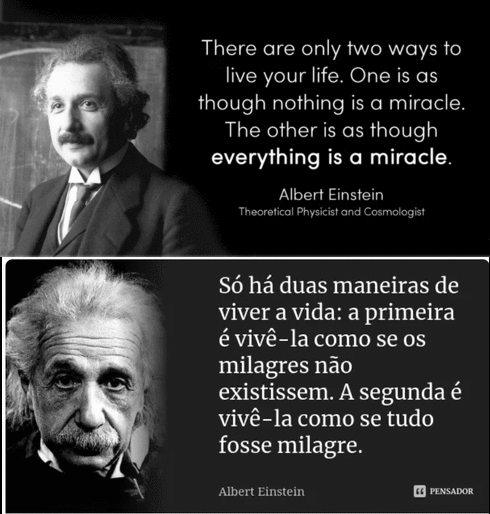
“TEMOS O DESTINO QUE MERECEMOS.
O NOSSO DESTINO ESTA DE
ACORDO COM OS NOSSOS MERITOS”
ALBERT EINSTEIN.
Imagination is more important than knowledge, for knowledge is limited while imagination embraces the entire world.
EL FUTURO SE CONSTRUYE HOY,EL SUCESSO NO ES FRUTO DE LA CASUALIDAD,SE HUMILDE ,APRENDE SIEMPRE CADA DIA.
AUTOR DO BLOG ENG.ARMANDO CAVERO MIRANDA SÃO PAULO BRASIL
“GRAÇAS A DEUS PELA VIDA,PELA MINHA FAMÍLIA,PELO TRABALHO.PELO PÃO DE CADA DIA,POR NOS PROTEGER DO MAL”
“SE SEUS PROJETOS FOREM PARA UM ANO,SEMEIE O GRÂO.SE FOREM PARA DEZ ANOS,PLANTE UMA ÁRVORE.SE FOREM PARA CEM ANOS,EDUQUE O POVO”
Power Electronics: A New Beginning By Slobodan Ćuk, TESLAco
Power Electronics progress depends on the progress in its two constituent areas: System Technology and Power Management Technology, which had been traditionally developed in the past in companies specializing in either one or the other area of expertise. System Technology companies, or Power Supply companies relied heavily on the use of the components (switches, drive and control circuits) developed by Power Management companies.
The System Technology popularly known as converter topologies has changed very little in last 50 years and is, in fact, the key reason why the Power Electronics as whole has progressed much less despite the tremendous advances made by Power Management companies in developing the new switching devices with ever increasing switching devices power and speed improvements and high performance digital control circuits.
The conventional topologies are analyzed and the sources of their deficiencies are established. This, in turns, leads to the new switching methods and the corresponding novel switching converter topologies which are overcoming all these deficiencies. However, no incremental change will do, but a fresh new look is needed. Hence what is needed is: Power Electronics: A New Beginning!
Dr. Slobodan Ćuk
Dr. Ćuk received his bachelor degree from Belgrade University, Yugoslavia, 1970, MSEE degree from University of Santa Clara, USA 1974 and her Ph.D. from Caltech, California , USA, 1976.
Dr. Ćuk was the full-time Professor of Electrical Engineering at the California Institute of Technology until January 1, 2000 where he conducted research and taught courses in Power Electronics and Fundamentals of Energy Processing. During his 25 years at Caltech, more than 35 students obtained Ph.D. degree in Power Electronics under his guidance. More than dozen of his former students are Professors of Power Electronics in U.S. and abroad while others are leading researchers in the industry.
For the invention of Integrated Magnetics Dr. Ćuk obtained a 1991 Edward Longstreth Medal from Franklin Institute which was for the first time in its 100 years history awarded to researchers in Power Electronics. His publications include over 100 scientific papers in the Power Electronics field and a three-volume book on Switched-Mode Power Conversion.
Over a span of 20 years, Dr. Ćuk has taught a number of public and in-house courses in United States, Europe and Far East, which were attended by over 4,000 Power Electronics specialists. In 1979, Dr. Ćuk founded TESLAco. He holds over 20 patents in switching power conversion filed. Over dozen patents on Ćuk Optimum Power Conversion technology are pending or are currently in preparation.
Dr. Ćuk’s Inventions and Discoveries
1. Optimum Topology Converter, known as the ĆUKconverter (1974)
2. Coupled-Inductor and Integrated Magnetics method (1975)
3. State-space averaging method (1975)
4. TESLAconverter (2000)
5. Hybrid-switching and Storageless-Switching Method (2009)
6. New DC-DC and Bridgeless AC-DC converter topologies (2010):
A study on Auto Transformer protective method
for AC electric railway system.
Son, Dong-Shic
Department of Railroad Engineering
The Graduate School of Green Railroad
Woosong University
An AC electric railway uses AT(auto transformer), BT(Booster
Transformer), and direct power feeding system. Today, as a result of an
increase in use of load current system, AT feeding system has became a
mostly and widely used system due to its profitability in high and
long-distance power feeding and inductive interference.
AT is a core facility of the AC electric railway, a major public
transportation, in AT traction power feeding system thus, the suspension of
train operation due to the malfunction of AT feeding system would causes
not only a high volume of civil petitions but also an interruption to the
power supply to the train that could bring a second incident.
In general, the power transformer protection is classified into electronic
protection that includes differential protection (87T), over current protection
(50/51), and earth fault protection (50/51N), and the mechanical protection
such as buchholz relay, sudden pressure relay, winding temperature indicator,
temperature indicator for insulation oil however, the failure in the operation of
AT is protected only by an alarm signal controlled by substation using
current and impedance relay. Therefore, to prevent the failure in mechanical
protection, sectioning post(SP), sub-sectioning post(SSP), and parallel post(PP)
needs to be protected by electronic protection as well as mechanical
protection. In addition, accidents related to AT traction power supply system
are divided into an outside (on railroad) accident mostly occurred due to
traction line earth(T-R earth), feeding line earth(F-R earth), sectioning line
earth(F-R earth), and short circuit(T-R short circuit) between feeding and
sectioning linen, and an inside (at substation) accident mostly occurred due to
earth and short circuit of AT winding furthermore, no matter what type of
accident related to AT traction power supply system occurs it is protected by
over current or impedance relay from substation Even though the AT
related accidents could result in the discontinuation of rail service due to an
inability to separate the feeder section, it is difficult to find whether the type
of accident is outside or inside. As a result, it unnecessarily costs long time
to deal with the accident because of unclearness of the cause.
About the Internet Archive https://archive.org/about/
The Internet Archive is a 501(c)(3) non-profit that was founded to build an Internet library. Its purposes include offering permanent access for researchers, historians, scholars, people with disabilities, and the general public to historical collections that exist in digital format.
Founded in 1996 and located in San Francisco, the Archive has been receiving data donations from Alexa Internet and others. In late 1999, the organization started to grow to include more well-rounded collections. Now the Internet Archive includes: texts, audio, moving images, and software as well as archived web pages in our collections, and provides specialized services for adaptive reading and information access for the blind and other persons with disabilities.
Fundamentos de la teoría de circuitos Popov VP - Основы теории цепей Попов В.П.
El libro corresponde al programa del curso "Fundamentos de la teoría de circuitos." Establece la teoría de circuitos eléctricos lineales con parámetros concentrados y distribuidos en condiciones de estado estacionario y transitorio; Se presta mucha atención al análisis de los fundamentos de circuitos no lineales resistivas, conceptos de matriz topológica, la teoría de grafos, los métodos de la máquina de formación de ecuaciones de equilibrio eléctricos, análisis de circuitos con fuentes controladas.
Development of Three-Phase On-Board Battery Charger for PHEV
without High-Capacity Electrolytic Capacitor
Ying-hao, Zhang
Department of Electrical Engineering
Graduate School, Myongji University
Advisor Professor Byung-Moon Han
A new two-stage on-board battery charger which can operate in both three-phase mode
and single-mode is proposed for plug-in hybrid electric vehicles (PHEVs). It consists of three
identical chargers which connect to battery in parallel, and each of them has a cascaded
structure of high frequency resonant converter with a constant switching frequency for
electrical isolation, and buck-boost converter for charging control and harmonic regulation of
input current under wide range line-input voltage. This structure uses small link capacitors so
that high-capacity electrolytic capacitors can be removed in automotive applications. An LLC
resonant converter is proposed in the first stage. The parallel buck-boost converters operating
in discontinuous conduction mode are employed in the second stage, so that the voltage stress
of components could be reduced and the simple controller can be used to control charging
current. Digital control of converter is realized by applying DSP (Digital Signal Processor)
that performs constant current through duty control of buck-boost converter. Duty ratio of
LLC converter is unregulated. Proposed Converter stably operates in various load condition
(within 10kW) and it is proven that the proposed converter achieves efficiency of higher than
93% and power factor of higher than 0.99 through experiment..
HOJE SURFANDO NA WEB ENCONTRE ESTE INTERESANTE LIVRO EM PORTUGUES DO PROFESSOR CLAUDIO GRAÇA DA UNIVERSIDADE FEDERAL DE SANTA MARIA NA
SIGUENTE PAGINA WEB PODEM CONFERIR: http://coral.ufsm.br/cograca/eletro12
LINK ALTERNATIVO https://copy.com/JEd3vsLmNYRfGiLp
AGRADECIMENTO ESPECIAL AO PROFESSOR CLAUDIO GRAÇA Curso de Engenharia Mecânica POR DISPONIBILIZAR LIVREMENTE ESTE LIVRO EN SUA PAGINA NA WEB,ELE ESTA REALIZANDO UM PROJETO DE ENSINO A CURTA DISTANCIA DE FISICA PODEM CONFERIR ESTE GRANDIOSO PROJETO NAS PAGINAS WEB SIGUENTES:
LINK1 http://coral.ufsm.br/cograca/livro.htm
LINK2 http://coral.ufsm.br/cograca/
1. IDENTIFICAÇÃO.
Nome do Departamento: DELET - DEPARTAMENTO DE ENGENHARIA ELÉTRICA (http://www.ufrgs.br/delet/)
Nome da Atividade de Ensino: - ENG04074 - TEORIA DE CIRCUITOS I
Cursos(s) de Oferecimento: - ENGENHARIA ELÉTRICA
Caráter: - Obrigatória
Pré-requisitos por Curso:
FIS01182 – FÍSICA GERAL - ELETROMAGNETISMO
MAT01354 – CÁLCULO E GEOMETRIA ANALÍTICA II-A


.gif)