
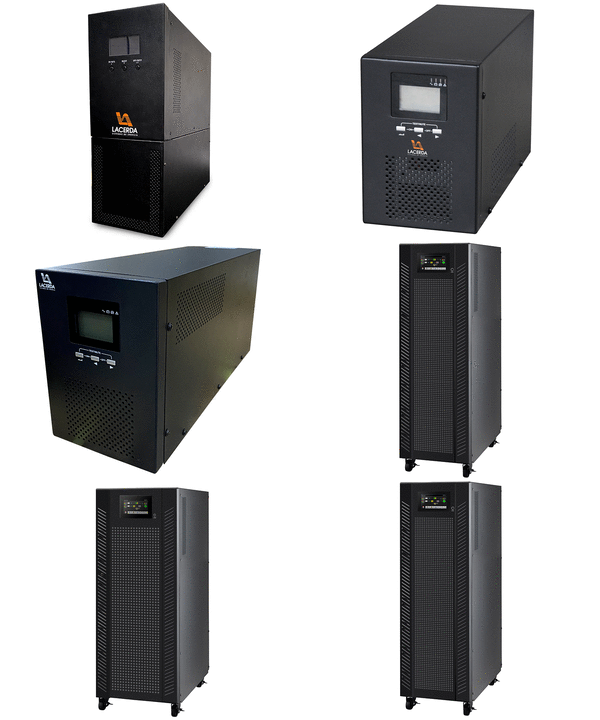


AUTOR DO BLOG ENG.ARMANDO CAVERO MIRANDA SÃO PAULO BRASIL

GIF 1 GIF 2

“GRAÇAS A DEUS PELA VIDA,PELA MINHA FAMÍLIA,PELO TRABALHO.PELO PÃO DE CADA DIA,POR NOS PROTEGER DO MAL”

“SE SEUS PROJETOS FOREM PARA UM ANO,SEMEIE O GRÂO.SE FOREM PARA DEZ ANOS,PLANTE UMA ÁRVORE.SE FOREM PARA CEM ANOS,EDUQUE O POVO”

https://picasion.com/

segunda-feira, 27 de janeiro de 2025

ESTUDO DE CONVERSORES ESTÁTICOS CA-CA MONOFÁSICOS E TRIFÁSICOS BASEADOS NO PRINCÍPIO DO CAPACITOR CHAVEADO Mauricio Dalla Vecchia, Telles Brunelli Lazzarin, Ivo Barbi Universidade Federal de Santa Catarina – UFSC, Florianópolis – SC, Brasil


 ESTUDO DE CONVERSORES ESTÁTICOS CA-CA MONOFÁSICOS ETRIFÁSICOS BASEADOS NO PRINCÍPIO DO CAPACITOR CHAVEADO Mauricio Dalla Vecchia, Telles Brunelli Lazzarin, Ivo BarbiUniversidade Federal de Santa Catarina – UFSC, Florianópolis – SC, Brasil e-mail: m.dallavecchia90@gmail.com, telles@inep.ufsc.com, ivobarbi@inep.ufsc.br 

 Resumo – Este artigo apresenta uma célula básica bidirecional a capacitor chaveado para a conversão direta CA-CA. A partir desta célula são discutidas duas topologias CA-CA, uma monofásica e outra trifásica, e proposta uma terceira topologia CA-CA trifásica com número de interruptores reduzido, denominada deltaaberto. Essas topologias utilizam apenas capacitores e interruptores no estágio de potência, apresentam ganho fixo, operam em malha aberta, com valores constantes de razão cíclica e frequência, apresentam alta eficiência e elevada densidade de potência, típicas características de capacitores chaveados. A principal vantagem das topologias abordadas é a não utilização de elementos indutivos no circuito de potência, o que reduz significativamente o volume e peso da estrutura. Os conversores são adequados para a implementação de transformadores eletrônicos e possuem potencial para substituir o autotransformador em aplicações residenciais, comerciais e industriais. Estudo, análise e comprovação experimental são apresentados para os seguintes conversores: monofásico de 1 kW, trifásico de 6 kW e trifásico com conexão delta-aberto de 3,5 kW, todos para 220 V/110 V. As topologias operam com uma frequência de comutação de 100 kHz. Resultados experimentais expressivos, como eficiência em torno de 93 % em plena carga, são apresentados e comprovam o potencial de aplicação das topologias.

domingo, 26 de janeiro de 2025

Simple Method to Estimate Battery Lifetime and Upkeep of Lead-Acid and Lithium-Ion Batteries-Pedro C. Bolsi 1,2, Edemar O. Prado 1,2, Romario J. Nazaré 2, Hamiltom C. Sartori 1, José R. Pinheiro 1,2 1Universidade Federal de Santa Maria, Santa Maria - RS, Brasil 2Universidade Federal da Bahia, Salvador - BA, Brasil


Simple Method to Estimate Battery Lifetime and Upkeep of Lead-Acid and Lithium-Ion Batteries

 Pedro C. Bolsi 1,2, Edemar O. Prado 1,2, Romario J. Nazaré 2, Hamiltom C. Sartori 1, José R. Pinheiro 1,2 

1Universidade Federal de Santa Maria, Santa Maria - RS, Brasil 

2Universidade Federal da Bahia, Salvador - BA, Brasil

 e-mail: pedrobolsi@ufba.br, edemar.prado@ufba.br, romario.jesus@ufba.br, hamiltomsar@gmail.com, jrenes@gepoc.ufsm.br

 ABSTRACT This work provides an event-oriented method to model and predict the lifetime of leadacid and lithium-iron phosphate batteries. An ampere-hour integration method is proposed to be used in conjunction with the event-oriented method to achieve higher accuracy. The methods are applied to lead acid and lithium-iron phosphate batteries on a commercial 1 kW single-office/home-office uninterruptible power supply (UPS). Additional circuits for measurements, or microprocessors are avoided to not increase the UPS cost, reducing its market competitiveness. The usefulness of the proposed approach is demonstrated by an upkeep analysis based on the cost of the battery and the service time for each battery technology.

VIEW FULL PAPER: https://journal.sobraep.org.br/index.php/rep/article/view/981

DOWNLOAD : https://journal.sobraep.org.br/index.php/rep/article/view/981/881


Design of Uninterruptible Power Supply Inverters for Different Modulation Techniques Using Pareto Front for Cost and Efficiency Optimization-Edemar O. Prado , Pedro C. Bolsi , Hamiltom C. Sartori and José R. Pinheiro-BRASIL


Design of Uninterruptible Power Supply Inverters for Different Modulation Techniques Using Pareto Front for Cost and Efficiency Optimization Edemar O. Prado 1,2,* , Pedro C. Bolsi 1,2 , Hamiltom C. Sartori 2 and José R. Pinheiro 1,2 

 1 Energy Efficiency Lab, LABEFEA, Federal University of Bahia, Salvador 40170-110, BA, Brazil 
2 Power Electronics and Control Research Group, GEPOC, Federal University of Santa Maria, Santa Maria 97105-900, RS, Brazil * Correspondence: edemar.prado@ufba.br 

 Abstract: This work presents a design for uninterruptible power supply inverters using Pareto front optimization for improved cost and efficiency. Three PWM modulation techniques applied to the full-bridge inverter are analyzed. As a result, the best MOSFET design solution in terms of the cost and efficiency of the inverter is evaluated based on a database with 47 power MOSFETs. Using the Pareto front, the optimal and sub-optimal solutions are compared, considering the three modulation techniques and the characteristics of MOSFETs manufactured for different voltage levels. Thermal and electrical measurements are used to validate the models.


LCL filter based high power density AC/DC converter for fast charging applications-Nguyen Dinh Tuyen, Nguyen Van Minh Tam, Truong Phuoc Hoa Department of Power Delivery, Faculty of Electrical and Electronics Engineering, Ho Chi Minh City University of Technology


 Journal homepage: http://ijpeds.iaescore.com LCL filter based high power density AC/DC converter for fast charging applications Nguyen Dinh Tuyen, Nguyen Van Minh Tam, Truong Phuoc Hoa

 Department of Power Delivery, Faculty of Electrical and Electronics Engineering, Ho Chi Minh City University of Technology (HCMUT), Vietnam National University (VNU), Ho Chi Minh City, Vietnam 

 ABSTRACT This paper introduces a LCL filter design tailored for a 40 kW three-phase grid-connected converter utilized in electric vehicle onboard fast chargers. In contrast to conventional filters, the LCL filter finds extensive application in AC/DC converters for power factor correction, thanks to its enhanced harmonic reduction and improved stability of the system. The parameters of LCL filter are devised based on considerations such as the system’s power, the frequency of the alternating current (AC) input, and the PWM frequency, determined through simulation and comprehensive theoretical analysis. By implementing a dual-current closed-loop control strategy, the system ensures a robust response for both the current on the AC side of the converter and the voltage on the direct current (DC) side. The analysis of the system’s performance includes rapid dynamic response, system efficiency, AC current harmonic, and DC ripple voltage. Both simulation and experimental results are presented to validate the proposed design for the LCL filter.


A single-stage full bridgeless boost half-bridge AC/DC converter with bidirectional switch Mohamad Affan Bin Mohd Noh1, Mohd Rodhi Bin Sahid2, Vinesh Thiruchelvam3 1,3School of Engineering, Asia Pacific University of Technology & Innovation, Malaysia 1,2School of Electrical Engineering, Universiti Teknologi Malaysia, Malaysia


 International Journal of Power Electronics and Drive Systems (IJPEDS) Vol. 12, No. 4, December 2021, pp. 2336~2348 ISSN: 2088-8694, DOI: 10.11591/ijpeds.v12.i4.pp2336-2348 

A single-stage full bridgeless boost half-bridge AC/DC converter with bidirectional switch Mohamad Affan Bin Mohd Noh1, Mohd Rodhi Bin Sahid2, Vinesh Thiruchelvam3 1,3School of Engineering, Asia Pacific University of Technology & Innovation, Malaysia 1,2School of Electrical Engineering, Universiti Teknologi Malaysia, Malaysia 

 ABSTRACT
 Article history: Received Mar 22, 2021 Revised Oct 18, 2021 Accepted Oct 25, 2021 This paper proposed an isolated full bridgeless single stage alternating current-direct current (AC-DC) converter. The proposed converter integrates the operation of a pure bridgeless power factor correction with input boost inductor cascaded with center-tap transformer and half bridge circuit. In addition, the bidirectional switch can be driven with single control signal which further simplifies the controller circuit. It was proven that this converter reduced the total number of components compared to some conventional circuit and semi-bridgeless circuit topologies. The circuit operation of the proposed circuit was then confirmed with the small signal model, large signal model, circuit simulation and then verified experimentally. It was designed and tested at 115 Vac, 50 Hz of input supply, and 20 Vdc output voltage with maximum output power of 100 W. In addition, the crossover distortion at the input current was minimized at high input line frequency.