
.gif)




Challenges
and Solutions for Power Grid Stability with the Expansion of AI Data Centers
Eng.
Armando Cavero Miranda (UPS Specialist)

▶AI data centers experience
extreme power fluctuations on the scale of milliseconds to minutes.Due to the
synchronization characteristics of hundreds of thousands of GPUs during
checkpoints, synchronization delays, and training completion, resulting in a
greater amplitude of variation.10 times larger compared to the traditional cloud.In peak and trough
situations, the total load can drop drastically, for example, from 100
(normalized base) to 42, representing a direct risk to system stability.
▶These Sudden load fluctuations
are difficult to match with the response speed (MW/min) of existing generators.When combined with the
decrease in system inertia due to the expansion of renewable energies, they can
lead to the risk ofchain of blackoutsAccording to an analysis by ERCOT, there is a possibility of
widespread voltage instability in the event of a simultaneous power outage
exceeding 2.5 GW.
▶As countermeasures,
hardware-based solutions are being implemented in conjunction, such as BESS (Battery Energy
Storage System), grid-connected UPS (Uninterruptible Power Supply) and
synchronous capacitors, software controls such as workload-aware smoothing and institutional
measures such asmandatory LVRT (Voltage Sag Support) and conditional connection
regulations.
1. Prospects for
Accelerated Growth in Energy Demand from Global Data Centers
In 2024, data center energy consumption represented 1.5%
(415 TWh) of global electricity consumption. It is expected to exceed 945 TWh
by 2030, more than doubling. [1)]
The main reason for the increased energy demand in data
centers is the growing demand for AI and digital services.

The US currently accounts for approximately 35-40% of the
global data center market (based on GW).
2. Load Fluctuation
Patterns of AI Data Centers
❏Load Fluctuation Characteristics of AI Data Centers
During GPU batch processing, power consumption spikes during array operations, and drops dramatically during data transfer and synchronization
- Checkpoint EventDuring the checkpoint
process to save progress, the charge drops to near 'zero' for
milliseconds, followed by a sharp increase as it instantly recovers.
- Synchronization DelayDuring parallel summation
(AllReduce) operations on clusters of hundreds of thousands of GPUs,
network transmission delay causes some devices to remain idle for a few
seconds.
- End of TrainingFollowing a large-scale
operation, if there is no immediate subsequent workload, gigawatt-scale
loads can be disconnected simultaneously in a single event.
※Checkpoint: The process of saving intermediate AI
learning results, allowing the execution of the same point to be resumed later.
※Parallel Sum Operation (AllReduce): A
communication operation in distributed learning where the results calculated by
each GPU (e.g., gradients from matrix operations) are summed collectively, and
then the result is distributed equally to all GPUs. Because all devices must
wait/synchronize simultaneously during this process, patterns of instantaneous
load drops or peaks may occur.
※According to some data, based on
Google Cloud data, it is reported that under specific conditions, AI workloads
showed a load fluctuation approximately 10 times greater (1.5MW → 15MW)
compared to the traditional cloud, but these are values from individual cases
and the proportion relative to total equipment was not disclosed.
3. Measures to
Respond to Sudden Load Fluctuations
☐Hardware Solutions
❍Battery Energy Storage System (BESS)
- It acts as a physical
"shock absorber" that absorbs abrupt fluctuations in AI load.
- It actively manages power
quality with Fast Frequency Response (FFR) on a millisecond scale and
contributes to improving LVRT capability.
- It goes beyond mere cost,
transforming into a revenue asset through peak shaving, energy arbitrage,
and participation in the ancillary services market.
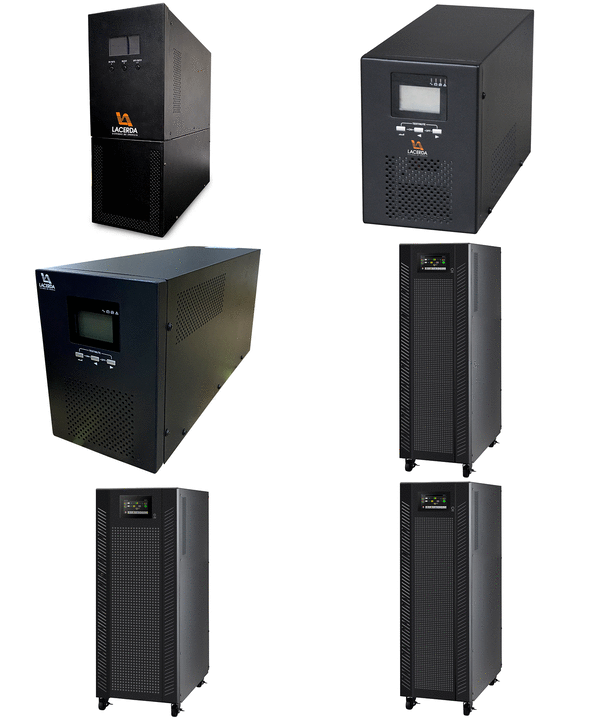
❍Grid-Interactive Uninterruptible Power Supply
(GIPS)
※An Uninterruptible Power Supply (UPS) functions to provide stable power for a certain period immediately when there is a momentary interruption in the
power supply or voltage fluctuation. The power is drawn from the electrical grid and used.
- It evolves from a passive
emergency power source to a Distributed Energy Resource (DER) that
actively contributes to grid stabilization.
- It monitors the network
frequency in real time, discharging when the frequency drops and charging
when it rises, contributing to stabilization.
※It was marketed at Microsoft's Dublin data center, also serving as a backup power source.
❍Synchronous Capacitors and Other Equipment
- They provide the physical
inertia of the electrical grid, which has been reduced due to the
increased participation of renewable energies, ensuring frequency
stability.
- They provide reactive power
to dynamically support the voltage and increase the robustness of the
system. [6)]
- STATCOM/SVCThey provide fast voltage
support, and Grid-Forming Inverters provide virtual inertia, being used in
a complementary way with BESS.
※STATCOM (Static Synchronous
Compensator): A device that uses power electronics equipment to supply/absorb
reactive power in real time, maintaining a stable voltage.
※SVC (Static Reactive Power
Compensator): A device that controls the reactive power of the network to
reduce voltage fluctuations. It has a slower response than STATCOM, but is
cheaper and widely used.
※Grid-Forming Inverter: A device where
distributed sources such as solar power and batteries create their own
voltage/frequency reference, acting as a "mini power plant" to
stabilize the grid.
New Challenges Presented by
AI Data Centers
The AsExtreme load fluctuations
on a millisecond-second-minute scale in AI data centers.They can fundamentally
threaten the stability of the existing electrical grid.
·
They originate fromintrinsic characteristics of AI learning workloadswhere hundreds of
thousands of GPUs operate in a synchronized manner, unlike the asynchronous
workloads of the traditional cloud.
·
Due to unpredictable events such as checkpoints, synchronization
delays, and training terminations, loads on the GW scale change abruptly in
milliseconds.
·
THEThe response speed in minutes (MW/min) of existing generators is
not capable of handlingwith this, and in addition, thereduction in system inertia
due to increased renewable energyThis can further amplify the vulnerability.
OOsimultaneous tripping of large-scale loadscould emerge as a real
risk ofchain blackout.
This is not merely a theoretical scenario,
but follows a path similar to large-scale energy collapses that have already
occurred.
·
The April 2025 event in the Iberian Peninsula (Spain, Portugal),
where 2.2 GW of generation was lost and the entire grid collapsed in 27
seconds, is a representative example.
·
The isolated structure of the Texas power grid, lacking external
interconnections, is similar to that of the Iberian Peninsula in Europe,
exposing it to the same risk of chain reaction collapse.
References
-Donnellan, D., Lawrence, A., Bizo, D., and Judge,
P., “Uptime Institute
Global Data Center
Survey 2024”, Uptime Institute, 2024.
-Park
Chan-guk, Assistant Professor, Faculty of Climate Change Convergence, Hankuk
University
-Energytrackerasia, “AI Data Center Development in Japan and Clean
Energy
Transition”, 2025.
-Entsoe,
“Synchronous Condensers,” 2025a.
-[Paper Review] Power Stabilization for AI Training Datacenters


