


AUTOR DO BLOG ENG.ARMANDO CAVERO MIRANDA SÃO PAULO BRASIL

GIF 1 GIF 2

“GRAÇAS A DEUS PELA VIDA,PELA MINHA FAMÍLIA,PELO TRABALHO.PELO PÃO DE CADA DIA,POR NOS PROTEGER DO MAL”

“SE SEUS PROJETOS FOREM PARA UM ANO,SEMEIE O GRÂO.SE FOREM PARA DEZ ANOS,PLANTE UMA ÁRVORE.SE FOREM PARA CEM ANOS,EDUQUE O POVO”

https://picasion.com/


segunda-feira, 12 de outubro de 2026

High voltage semiconductor voltage pulse generator for capillary discharge formation in soft X- ray radiation source Andrey A. Samokhvalova,b , Kirill A. Sergushichevb , Stepan I. Eliseevb,c , Artyom A. Smirnovb ✉, Maria V. Timshinab , Timur P. Bronzovb a Saint-Petersburg National Research University of Information Technologies, Mechanics and Optics, Saint-Petersburg, Russian Federation


High"voltage semiconductor voltage pulse generator for capillary discharge formation in soft X"ray radiation source Andrey A. Samokhvalova,b , Kirill A. Sergushichevb , Stepan I. Eliseevb,c , Artyom A. Smirnovb ✉, Maria V. Timshinab , Timur P. Bronzovb 

 Saint-Petersburg National Research University of Information Technologies, Mechanics and Optics, Saint-Petersburg, Russian Federation b «Laboratory V.A. Burtseva» LLC, Saint-Petersburg, Russian Federation c St. Petersburg State University, Saint-Petersburg, Russian Federation

 Abstract. The results of the development of a high-voltage semiconductor voltage generator (based on IGBT transistors) with a pulse transformer and the results of experiments on generating a capillary discharge using it on a compact gas-discharge source capable of generating pulses of soft X-ray radiation (SXR) in the area of the socalled «water window» — with wavelength in the range of 2.4...4.4 nm. Methods for designing a high-voltage pulse voltage pulse generator are described: theoretical calculations and results of modeling the electrical circuit diagram in the LTSpice software package, the developed design of a pulse transformer based on N87 ring ferrites and the generator itself is described, the results of its operation as part of a compact gas-discharge radiation source are presented and analyzed. The prospects of using such a high-voltage generator (with semiconductor transistor switches) with a pulse transformer as part of a soft X-ray radiation source are shown due to its technical and operational features: the developed generator is capable of operating from an alternating current network of 380 V/50 Hz in a frequency-burst mode (with a repetition rate of the generated voltage pulses up to 600 Hz) and charges the capillary capacitance of the SXR source to a voltage of more than 20 kV in a time of about 4 μs, has small dimensions, does not create pulsed high-frequency interference and false alarms, and also has stable output (amplitude-temporary) parameters.

ORIGINAL RUSSIAN LANGUAGE:https://journals.rudn.ru/engineering-researches/article/download/37372/22992

 TRANSLATED FROM RUSSIAN TO ENGLISH :https://www.mediafire.com/file/704heq0czec2pcj/Highvoltage+semiconductor+voltage+pulse+generator-ENGLISH.pdf/file

INSTRUMENTS AND METHODS OF INVESTIGATION PACS - Physical principles of filtration and the design of terahertz radiation filters A.K. Kaveev, G.I. Kropotov-Uspekhi Fizicheskikh Nauk, Russian Academy of Sciences


Physical principles of filtration and the design of terahertz radiation filters 

 Contents
1. Introduction 169
2. Basic physical principles of THz radiation filtering 170
2.1 Filtration of THz radiation in absorbing layers; 2.2 Filtering of THz radiation using metamaterials
3. THz filters based on absorbing materials 175
3.1 Spectral studies of materials for fabricating THz cutoff filters; 3.2 Cutoff filters
4. THz filters based on metamaterials 177
4.1 Geometries and equivalent circuits of FSSs used as real THz filters; 4.2 THz notch filters; 4.3 Filters based on
resonant switching by photoexcitation; 4.4 THz high-pass filters; 4.5 Technologies for manufacturing metamaterials
for THz filters and other FSS-based passive optical elements
5. THz polarization filters 183
6. THz plasmonic Filters 184
7. Exotic THz filter 184
8. Conclusions 186
References

 Abstract. Present review examines the basic physical principles of operation of terahertz radiation filters. The main types of filters are presented, namely, based on absorbing/scattering materials, metamaterials (frequency-selective surfaces), interference, polar- ization, and some exotic types. The basic principles of calculating the filters transmission based on matrix methods are described, as well as based on solving Maxwell's equations. The areas of application of THz filters are listed. 

FULL PAPER : LINK1 :https://ufn.ru/ufn2026/ufn2026_2/ufn262e.pdf

LINK2 : https://www.mediafire.com/file/nj0pxmeqw6wlyx9/Physical+principles+of+filtration+and+the+design+of+terahertz+radiation.pdf/file 

sexta-feira, 9 de outubro de 2026

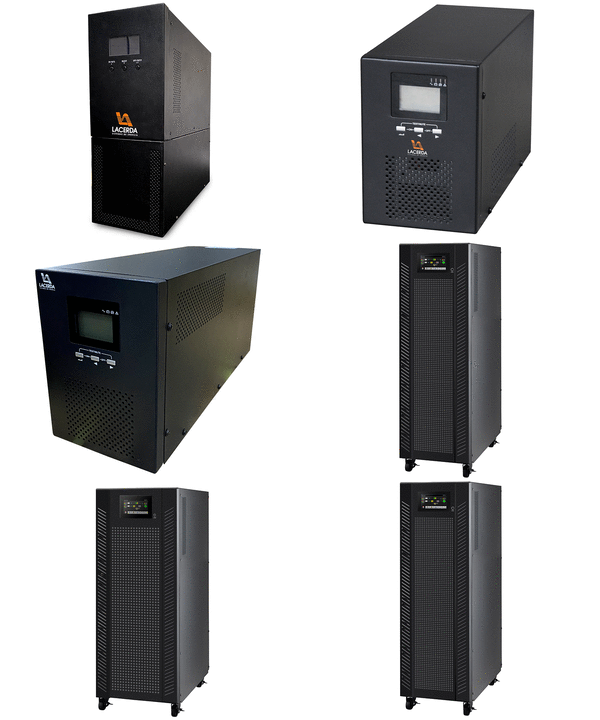
TESTE PLACA CARREGADOR DE BATERIAS UPS ONLINE 2KVA -6 BATERIAS DE 12VDC


THE IGBT TEST SETUP DESIGN Master Thesis By Kun Liu Abdirahman Hirsi-Division of Electric Power Engineering Department of Energy and Environment CHALMERS UNIVERSITY OF TECHNOLOGY


THE IGBT TEST SETUP DESIGN Master Thesis By Kun Liu Abdirahman Hirsi-Division of Electric Power Engineering Department of Energy and Environment CHALMERS UNIVERSITY OF TECHNOLOGY-Gothenburg, Sweden 2008 

Abstract 

An experimental half bridge converter setup is designed in order to explore the switching characteristics and losses of a new type of IGBT module. A specific digital control circuit and a drive circuit for an IGBT are designed and integrated into one PCB which can provide different kinds of precise IGBT gate signals. The switching characteristics and losses are investigated under different parameters both in a hardware and a simulation. It can be observed that the switching losses are increasing with the increase of voltage and current levels. Increasing the gate resistance also tends to increase the IGBT switching losses, while the reverse recovery losses of the free-wheeling diode decrease. The switching characteristics of the IGBT are not affected by temperature, but the reverse recovery losses increase with the temperature. The stray inductance has a negative effect, since it causes the oscillation both in the voltage and current waveforms.

 LINK1 : https://www.mediafire.com/file/dpy9vooyx34f23h/IGBT-THESIS.pdf/file

LINK2: https://mega.nz/file/BMFXHRKJ#7gVHFUzX568UFvwuPZWM4YL5t0X-JcTThyXNjN7WBcE 

quinta-feira, 8 de outubro de 2026

동북아 슈퍼그리드의 HVDC 계통 및 고장 해석 연구- A study on the HVDC system and fault analysis of the Northeast Asian Supergrid-BY MOON BYUNG-SOO - Department of Electrical Engineering Graduate School of Chosun University


 ABSTRACT 

A Study on the HVDC System and Fault Analysis of the Northeast Asian Supergrid MOON BYUNG-SOO Advisor: Prof. Choi Hyo-Sang Ph.D. Department of Electrical Engineering Graduate School of Chosun University

 The thesis's topic is “A study on the HVDC system and fault analysis of the Northeast Asian Supergrid.”In the 21st century, as energy conversion accelerates due to global warming and fossil fuel depletion, the establishment of a supergrid linking power grids among countries is emerging as a major concern. Northeast Asia is rich in renewable energy resources such as wind and solar power in Mongolia and the interior of China, and is geographically adjacent to large-scale power demands in Korea, Japan, and China, providing favorable conditions for cross-border power supply and demand balancing. As a result, strategies for securing energy security and realizing carbon neutrality by 2050 are being developed, and to achieve these goals, it is necessary to establish measures to address the issues of frequency differences among AC systems when linking power grids among countries and the increase in fault current that occurs when connecting to high-voltage direct-current (HVDC) systems. In this paper, the characteristics of fault currents generated in the HVDC transmission system were analyzed, and the applicability of reduction technology was reviewed. In chapter 2, sections 1 and 2, the technical trends of the HVDC transmission system, the transmission methods and interconnection schemes, and the basic principles and modulation techniques of the VSC-HVDC system were examined to present the system configuration direction suitable for HVDC connection. Section 3 systematically summarized the principle of superconducting fault current limiters (SFCLs), DC interruption theory, types of DC interruption technologies, and the operating principles of DC circuit breakers (DCCBs). Section 4 describes the fault analysis theory for the high voltage alternating current (HVAC) system and the specification of fault current calculation based on the IEC 60909. In addition, the basic theories of unbalanced faults such as single-line-to-ground, double-line-to-ground, line-to-line, and three-phase faults, and protection relay were described. In chapter 3, PSCAD/EMTDC simulation design and interpretation were conducted. In section 1, simulation parameters for the application of the symmetric coordinate method were set up. Using this parameter, a symmetric component (P–N–Z) analysis based on the x-axis was performed on the three-phase asymmetric failure types of one-line ground fault, two-line ground fault, and line-to-line short circuit. Using this, electrical characteristics such as instantaneous values of voltage and current for each failure type, unbalance, and change in symmetric components were analyzed. In section 2, an VSC-HVDC grid based on the modular multi level converter (MMC) was constructed between Weihai, China and Taean, Korea, and its parameters were defined. In section 3, the DC voltage, current, and power graphs of MMC were analyzed by steady-state simulation, and the voltage, current, and power characteristics of AC1 (Weihai, China) and AC2 (Taean, Korea) were analyzed. In section 4, a transient state simulation was executed in a PSCAD/EMTDC environment, and the characteristics of the VSC-HVDC system based on a MMC. Also the DC transmission system, and the AC1 and AC2 systems were analyzed. By setting four fault points (F1-F4) in the HVDC ±500 kV, 350 km transmission section, the DC ground current generated during the one-line ground failure of the P (+) and N (-) poles, and the AC voltage, current, and power characteristics of the sending point and the receiving point were analyzed. In addition, the voltage, current, and power characteristics of the AC1, AC2, and DC systems were analyzed in the event of a one-line ground fault, two-line ground fault, between lines, and three-phase short circuits of the AC1 and AC2 systems.

FULL THESIS:https://www.riss.kr/search/detail/DetailView.do?p_mat_type=be54d9b8bc7cdb09&control_no=58a12d105532aee7ffe0bdc3ef48d419&keyword=HVDC