AUTOR DO BLOG ENG.ARMANDO CAVERO MIRANDA SÃO PAULO BRASIL

.gif)
“GRAÇAS A DEUS PELA VIDA,PELA MINHA FAMÍLIA,PELO TRABALHO.PELO PÃO DE CADA DIA,POR NOS PROTEGER DO MAL”
“SE SEUS PROJETOS FOREM PARA UM ANO,SEMEIE O GRÂO.SE FOREM PARA DEZ ANOS,PLANTE UMA ÁRVORE.SE FOREM PARA CEM ANOS,EDUQUE O POVO”

https://picasion.com/


segunda-feira, 8 de setembro de 2014

domingo, 7 de setembro de 2014
Ph.D. Thesis Rechargeable lithium battery energy storage systems for vehicular applications PhD. Candidate: Tarun Huria UNIVERSITÀ DI PISA Engineering School “Leonardo da Vinci”


LINK
http://www.dsea.unipi.it/Members/huriaw/phd-thesis.pdf
sábado, 6 de setembro de 2014
Modular Multilevel Converters for HVDC power stations SERBIA, Nicola Institut National Polytechnique de Toulouse (INP Toulouse)


SUMMARY
This work was performed in the frame of collaboration between the Laboratory on Plasma and Energy Conversion (LAPLACE), University of Toulouse, and the Second University of Naples (SUN). This work was supported by Rongxin Power Electronic Company (China) and concerns the use of multilevel converters in High Voltage Direct Current (HVDC) transmission. For more than one hundred years, the generation, the transmission, distribution and uses of electrical energy were principally based on AC systems. HVDC systems were considered some 50 years ago for technical and economic reasons. Nowadays, it is well known that HVDC is more convenient than AC for overhead transmission lines from 800 - 1000 km long. This break-even distance decreases up to 50 km for underground or submarine cables. Over the twenty-first century, HVDC transmissions will be a key point in green electric energy development. Due to the limitation in current capability of semiconductors and electrical cables, high power applications require high voltage converters. Thanks to the development of high voltage semiconductor devices, it is now possible to achieve high power converters for AC/DC conversion in the GW power range. For several years, multilevel voltage source converters allow working at high voltage level and draw a quasi-sinusoidal voltage waveform. Classical multilevel topologies such as NPC and Flying Capacitor VSIs were introduced twenty years ago and are nowadays widely used in Medium Power applications such as traction drives. In the scope of High Voltage AC/DC converters, the Modular Multilevel Converter (MMC), proposed ten years ago by Professor R. Marquardt from the University of Munich (Germany), appeared particularly interesting for HVDC transmissions.
LINK
http://hal.archives-ouvertes.fr/docs/00/94/53/75/PDF/SERBIA_2014.pdf
Power Loss Modeling of Individual IGBT and Advanced Voltage Balancing Scheme for MMC in VSC-HVDC System Gum Tae Son*, Soo Hyoung Lee** and Jung-Wook Park

Power Loss Modeling of Individual IGBT and Advanced Voltage Balancing Scheme for MMC in VSC-HVDC System Gum Tae Son*, Soo Hyoung Lee** and Jung-Wook Park†
Abstract – This paper presents the new power dissipation model of individual switching device in a high-level modular multilevel converter (MMC), which can be mostly used in voltage sourced converter (VSC) based high-voltage direct current (HVDC) system and flexible AC transmission system (FACTS). Also, the voltage balancing method based on sorting algorithm is newly proposed to advance the MMC functionalities by effectively adjusting switching variations of the sub-module (SM). The proposed power dissipation model does not fully calculate the average power dissipation for numerous switching devices in an arm module. Instead, it estimates the power dissipation of every switching element based on the inherent operational principle of SM in MMC. In other words, the power dissipation is computed in every single switching event by using the polynomial curve fitting model with minimum computational efforts and high accuracy, which are required to manage the large number of SMs. After estimating the value of power dissipation, the thermal condition of every switching element is considered in the case of external disturbance. Then, the arm modeling for highlevel MMC and its control scheme is implemented with the electromagnetic transient simulation program. Finally, the case study for applying to the MMC based HVDC system is carried out to select the appropriate insulated-gate bipolar transistor (IGBT) module in a steady-state, as well as to estimate the proper thermal condition of every switching element in a transient state.
LINK
http://www.jeet.or.kr/LTKPSWeb/pub/pubfpfile.aspx?ppseq=1039
terça-feira, 2 de setembro de 2014
domingo, 31 de agosto de 2014
FLEXIBLE HIGH-POWER MULTI DC-DC CONVERTERS FOR TRAINS SYSTEMS ARASH ABBASALIZA BOORA PHD THESIS QUEENSLAND UNIVERSITY OF TECHNOLOGY


FLEXIBLE HIGH-POWER MULTI DC-DC CONVERTERS FOR TRAINS SYSTEMS
ARASH ABBASALIZA BOORA PHD THESIS
QUEENSLAND UNIVERSITY OF TECHNOLOGY AUSTRALIA
LINK
http://eprints.qut.edu.au/33208/1/Arash_Boora_Thesis.pdf
Research, Design and Implementation of Auxiliary Power Supplies APS for the Light Rail Vehicles DMITRI VINNIKOV


Research, Design and Implementation of Auxiliary Power Supplies for the Light Rail Vehicles DMITRI VINNIKOV THESIS ON POWER ENGINEERING, ELECTRICAL ENGINEERING, MINING ENGINEERING D24
Faculty of Power Engineering Department of Electrical Drives and Power Electronics
TALLINN UNIVERSITY OF TECHNOLOGY
Dissertation was accepted for the commencement of the degree of Doctor of Technical Science on October 17, 2005
Introduction
Electric traction is the only present-day solution for environmental problems in the city context. Electric traction is safe, economical, reliable and with a minimum environmental impact. The tram (or LRV, Light Rail Vehicle) is increasingly being seen as a cost-effective, environment-friendly and attractive solution to the urban transport crisis. New demands for energy efficient, reliable and safe rolling stock require purchasing of new vehicles, which is always a bulky financial burden on the rolling stock owner. In many cases, the replacement of entire rolling stock to obtain a new and more efficient technology is not economically feasible. Introduction of new energy saving technologies on old but not yet established own resource trams/LRVs in recent years has become a very attractive approach.
FULL THESIS
http://digi.lib.ttu.ee/archives/2006/2006-07/1153818082.PDF
quarta-feira, 27 de agosto de 2014


domingo, 24 de agosto de 2014
Power Quality Improvement of Single-Phase Grid-Connected Photovoltaic Inverter By Trung-Kien Vu


A Dissertation for the Degree of Doctor of Philosophy
Department of Information and Communications Engineering
Graduate School
Chungnam National University
ABSTRACT The economical and environmental impacts of fossil fuels have forced society to investigate sustainable solutions. The interest has focused on the renewable energy sources since the green and clean benefits. Consequently, investments in research and development in the field of power electronics have increased proportionally, especially in high voltage and high power grid-connected systems. The distributed power generation (DG) systems are becoming more common as the need for electric power increases because of taking advantage of using different energy sources such as wind and solar. A few examples are hybrid cars, solar houses or hospitals in remote areas where providing clean, efficient and reliable electric power is critical to the loads. In such systems, the power is distributed from the source side to the load side via power electronic converters in the system. At low and medium power applications, the task is often left to single-phase inverters where they are the only interface between sources connected to dc bus and loads connected to an ac bus. This dissertation investigates the power quality improvements to properly regulate the power flow between renewable source and the utility network. The control method for single-phase inverters used in low and medium power DG systems is based on (and also takes the advantage of) the well-known d-q transformation (which is mostly employed for three-phase converters’ analysis and control design).
sábado, 23 de agosto de 2014
THE NEXT GENERATION GRID-CONNECTED PV INVERTERS FOR HIGH PENETRATION APPLICATIONS By YAN ZHOU


THE NEXT GENERATION GRID-CONNECTED PV INVERTERS FOR HIGH
PENETRATION APPLICATIONS
By
YAN ZHOU
A Dissertation submitted to the
Department of Electrical and Computer Engineering
in partial fulfillment of the requirements for the degree of
Doctor of Philosophy Degree
THE FLORIDA STATE UNIVERSITY
ABSTRACT The increasing consumer demand and government incentives are driving the rapid growth of renewable energy generation. In particularly, the number of distributed photovoltaic (PV) system installations is increasing quickly. However, the high cost of the PV systems and the potential impacts on the safe operation of utility grid could become barriers to their future expansion. The transformerless cascaded multilevel inverter (CMI) is considered to be a promising topology alternative for low-cost and high-efficiency PV systems. This research work presents a single-phase transformerless PV system based on cascaded quasi-Z-source inverters (qZSI). In this system, each qZSI module is connected to a single PV panel and serves as a PV moduleintegrated converter (MIC).
FULL THESIS
http://diginole.lib.fsu.edu/cgi/viewcontent.cgi?article=7888&context=etd
quinta-feira, 21 de agosto de 2014
A Smart Lighting Management System with Satisfaction of User's Lighting Requirements Shin, Dae-Sik ; Kim, Hoon ;

Shin, Dae-Sik ; Kim, Hoon ;
In this paper, we proposed a smart lighting management system controls the lighting efficiently to reduce energy consumption while satisfying user's lighting requirements. The proposed system considers the available daylight intensity and indoor light source to satisfy the lighting requirements of each user according to the work environment. In addition, for user convenience, we have developed different user interfaces for lighting control including local interface, and remote interface through internet or Bluetooth for personal computer as well as smart phones. The proposed system satisfies the lighting requirements of each user according to the corresponding work environment. The proposed smart lighting management system utilizes the lighting energy efficiently, and can be considered a significant contribution towards future green buildings.
LINK
http://ocean.kisti.re.kr/downfile/volume/kiiee/JMJGCE/2013/v27n6/JMJGCE_2013_v27n6_1.pdf
Development of High Efficiency and High Power LED Package for Applying Silicone-Reflector Jeong, Hee-Suk ; Lee, Young-Sik ; Lee, Jung-Geun ; Kang, Han-Lim ; Hwang, Myung-Keun


Development of High Efficiency and High Power LED Package for Applying Silicone-Reflector Jeong, Hee-Suk ; Lee, Young-Sik ; Lee, Jung-Geun ; Kang, Han-Lim ; Hwang, Myung-Keun Journal of the Korean Institute of Illuminating and Electrical Installation Engineers, volume 27, issue 9, 2013, Pages 1-5 Abstract
We developed high-efficient 6W-LED package with simple structure by applying Heat Slug and silicone-reflector. LED package was manufactured in sized multi-chip structure having thickness of achieved by bonding silicon-reflector with prepreg on top of the plate after implementing the reflector placed on copper substrate Half Etching by thickness of . The luminous flux, luminous efficacy, correlated color temperature, color rendering index and thermal resistance of developed LED was evaluated, and it verified the application of products by applying it to 120W-LED road luminaires through simulation. The luminous efficacy of LED package reached over 130lm/W, and it is possible to be manufactured into 120W-LED road luminaires using 18 packages. In addition, the simulation results showed average of horizontal illuminance and overall illuminance uniformity that is suitable for three-lane road.
LINK
http://ocean.kisti.re.kr/downfile/volume/kiiee/JMJGCE/2013/v27n9/JMJGCE_2013_v27n9_1.pdf
quarta-feira, 20 de agosto de 2014
Quatro Medalhas Brasileiras Na Olimpíada Cone Sul

Hoje, 20 de agosto de 2014, foi divulgado o resultado da Olimpíada Matemática do Cone Sul. A Olimpíada Cone Sul é uma competição internacional da qual países são representados por equipes de 4 estudantes que não tenham feito 16 anos de idade em 31 de dezembro do ano imediatamente anterior à celebração da Olimpíada. A Olimpíada este ano aconteceu no Uruguai.
O resultado brasileiro foi:
Pedro Henrique Sacramento de Oliveira – Ouro
Gabriel Toneatti Vercelli – Ouro
João César Campos Vargas – Prata
Andrey Jhen Shan Chen – Bronze
Parabéns a toda a equipe brasileira!!
FONTE ORIGINAL
http://noic.com.br/2014/08/20/quatro-medalhas-brasileiras-na-olimpiada-cone-sul/
PERU PRIMEIRA POSIÇÃO XXV OLIMPIADA DE MATEMATICAS CONE SUL URUGUAY

PERU PRIMEIRA POSIÇÃO XXV OLIMPIADAS MATEMATICAS CONO SUL URUGUAY
Resultados de la cono sur. Christian Altamirano Modesto (50 puntos) medalla de oro Anthony Huarcaya Palomino (49 puntos) medalla de plata Jemisson Coronel Baldeón (46 puntos) medalla de plata Henry Fabrizio Felen Chavez (40 puntos) medalla de plata Peru (185) quedo primero por paises nuevamente.
CORTESIA DO DISTIGUIDO PROF. MATEMATICAS PERUANO JOHN CUYA
terça-feira, 19 de agosto de 2014


terça-feira, 12 de agosto de 2014
Dynamic Paralleling Behaviors of High Power Trench and Fieldstop IGBTs Yu Wu, Yaojie Sun, and Yandan Lin


LINK FULL PAPER
http://manuscript.jpe.or.kr/ltkPSWeb/pub/pubfpfile.aspx?ppseq=888
segunda-feira, 11 de agosto de 2014
"A importância da geração nuclear para se evitar uma crise de energia de base em 2025 no BRASIL" ENG. ANTONIO ERNESTO FERREIRA MULLER

"A importância da geração nuclear para se evitar uma crise de energia de base em 2025"
Segundo o presidente da Associação Brasileira de Engenharia Industrial (Abemi), engº Antonio Ernesto Ferreira Müller, algumas vozes internacionais influentes que sustentam não haver necessidade de se pensar em energia nuclear como alternativa para a geração de eletricidade limpa de base no Brasil – partindo da premissa de que o país tem um grande potencial de instalação de usinas hidrelétricas – estão incorrendo em equívoco por falta de conhecimento da realidade brasileira.
LEIA A INFORMAÇÃO COMPLETA NO SEGUINTE LINK
http://issuu.com/www.viapapel.com.br/docs/620
domingo, 10 de agosto de 2014
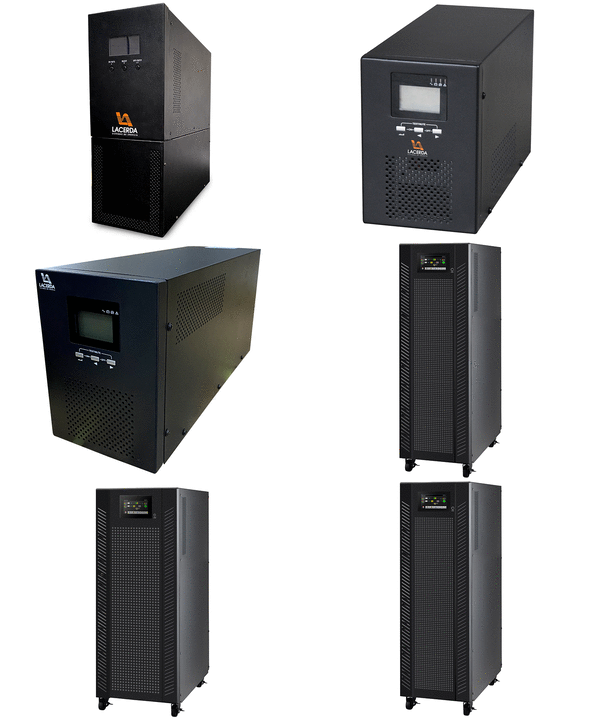
Fontes ininterruptas de energia. PORTAL O SETOR ELETRICO Por Hildo Guillardi, Paulo Serni, Danilo Brandão, Fernando Marafão, Luis de Pádua, Rafael Pazi e Flávio Gonçalves


Edição 101 - Junho de 2014
Artigo: Condicionamento de energia Por Hildo Guillardi, Paulo Serni, Danilo Brandão, Fernando Marafão, Luis de Pádua, Rafael Pazi e Flávio Gonçalves*
HILDO GUILLARDI JÚNIOR é engenheiro eletricista e mestre em engenharia elétrica (2013) pela UNESP/Bauru. Atualmente é doutorando em engenharia elétrica pela Unicamp. É integrante do grupo de pesquisa GASI.
PAULO JOSÉ AMARAL SERNI é engenheiro eletricista, mestre (1992) e Doutor em Engenharia Elétrica (1999) pela Unicamp. É professor da Universidade Estadual Paulista (Unesp) desde 1987 e docente do Curso de Engenharia de Controle e Automação – UNESP/Sorocaba desde 2012.
DANILO IGLESIAS BRANDÃO é engenheiro de Controle e Automação pela UNESP/Sorocaba (2011) e tem mestrado em engenharia elétrica pela UNESP/Bauru (2013). Atualmente é doutorando em engenharia elétrica pela Unicamp. Desde 2008 é bolsista FAPESP. É integrante dos grupos de pesquisa DSCE e GASI.
FERNANDO PINHABEL MARAFÃO é engenheiro eletricista, com mestrado e doutorado em Engenharia Elétrica pela Unicamp. Desde 2005, é professor assistente doutor no Campus de Sorocaba da Unesp, onde liderou o Grupo de Automação e Sistemas Integráveis (GASI) de 2007 a 2011.
LUIS OTÁVIO DE PÁDUA FILHO é engenheiro de Controle e Automação pela UNESP/Sorocaba (2009). Atualmente, trabalha como engenheiro de produto pela General Motors do Brasil, responsável por sistema de aquisição e instrumentação para testes de validação em automóveis.
RAFAEL RODRIGUES DA PAZ é engenheiro eletricista e mestre em Engenharia Elétrica pela UNESP/Sorocaba (2014). Atualmente, é professor da Faculdade de Engenharia de Sorocaba.
FLÁVIO ALESSANDRO SERRÃO GONÇALVES é engenheiro eletricista (1998), mestre (2001), doutor (2005) e pós-doutor (2007) em Engenharia Elétrica pela UNESP/Ilha Solteira (SP). Em 2011 foi pesquisador visitante na Universidade de Padova, Itália. Atualmente é professor e coordenador de curso de Engenharia de Controle e Automação no Campus de Sorocaba da Unesp.
LINK
http://www.osetoreletrico.com.br/web/component/content/article/57-artigos-e-materias/1440-fontes-ininterruptas-de-energia.html
sexta-feira, 8 de agosto de 2014
Development of LED Street Lighting Controller for Wind-Solar Hybrid Power System Yong-Sik Lee* and Jae-Hyeon Gim†


DOWNLOAD
http://www.jeet.or.kr/ltkPSWeb/pub/pubfpfile.aspx?ppseq=1058
Assinar:
Postagens (Atom)