
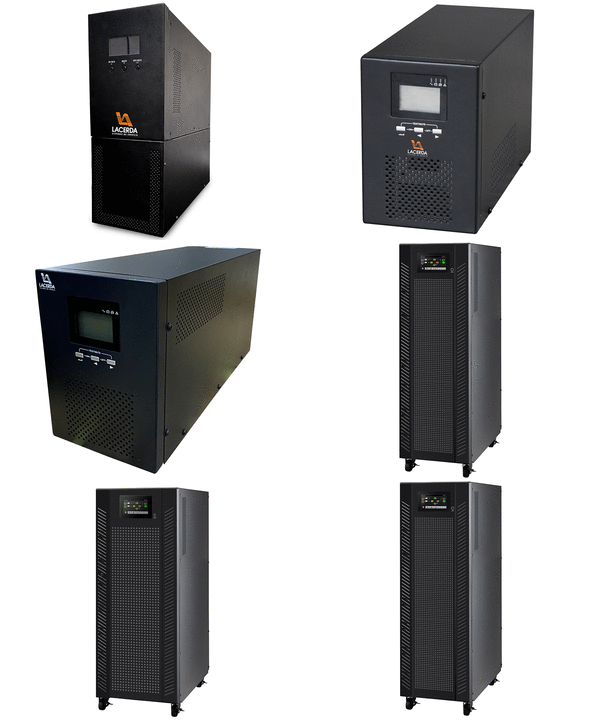


SINGLE -PHASE PROTOTYPE WITH INFINEON 1700V-JFETS
THREE-PHASE PROTOTYPE WITH INFINEON 1700V-JFETS
ON THE PERSPECTIVES OF WIDE-BAND GAP POWER DEVICES IN ELECTRONIC-BASED POWER CONVERSION FOR RENEWABLE SYSTEMS AUTHOR SAMUEL VASCONCELOS ARAÚJO
THESIS THE ACADEMIC DEGREE OF DOKTOR DER INGENIEUR-WISSENSHAFTEN (DR-ING).FACULTY OF ELECTRICAL ENGINEERING COMPUTER SCIENCES OF THE UNIVERSITY OF KASSEL GERMANY
FOREWORD
Power Electronics is taking an increasingly important role in our dailt lives, as it is the keystone not only to be efficient , but also cost effective and reliable use of electric energy in all possible fields of aplication;ranging from power supply from renewable energy sources to industry,IT and transportation.
The first revolution in this field of technology came in the 1960 with the viability of switched-mode power conversion ,owning to the emergence of BJTs operating at higher speeds.The development of MOSFETs and later IGBTs provided a futher step in the direction towards higher frequency and power levels.
The advent of power device based on silicon carbide (SiC) and gallium nitride (GAn) is curently pointing in the direction of a second revolution,whwre several paradigms concernig the design and performance of power conversion stages will be broken.
FULL THESIS
http://www.uni-kassel.de/upress/online/frei/978-3-86219-486-5.volltext.frei.pdf
Dr.Ing. SAMUEL VASCONCELOS ARAÚJO (FACULTY OF ELECTRICAL ENGINEERING COMPUTER SCIENCES OF THE UNIVERSITY OF KASSEL GERMANY) ,GRADUATION STUDENT IN THE FEDERAL UNIVERSITY OF CEARA (UFC-2005)
BRASIL WORKING IN THE GEPEC LABORATORY.
No Blog Eletrônica de Potência você encontrará informações sobre teses,artigos,seminarios,congressos,tecnologias,cursos,sobre eletrônica potência. “TEMOS O DESTINO QUE MERECEMOS. O NOSSO DESTINO ESTA DE ACORDO COM OS NOSSOS MERITOS” ALBERT EINSTEIN. Imagination is more important than knowledge, for knowledge is limited while imagination embraces the entire world. EL FUTURO SE CONSTRUYE HOY,EL SUCESSO NO ES FRUTO DE LA CASUALIDAD,SE HUMILDE ,APRENDE SIEMPRE CADA DIA.
AUTOR DO BLOG ENG.ARMANDO CAVERO MIRANDA SÃO PAULO BRASIL
“GRAÇAS A DEUS PELA VIDA,PELA MINHA FAMÍLIA,PELO TRABALHO.PELO PÃO DE CADA DIA,POR NOS PROTEGER DO MAL”
“SE SEUS PROJETOS FOREM PARA UM ANO,SEMEIE O GRÂO.SE FOREM PARA DEZ ANOS,PLANTE UMA ÁRVORE.SE FOREM PARA CEM ANOS,EDUQUE O POVO”

https://picasion.com/


terça-feira, 25 de novembro de 2014
segunda-feira, 24 de novembro de 2014
EMC: A mapping for the Compact Muon Solenoid CMS experiment Fernando José González Arteche TESIS DOCTORAL UNIVERSIDAD DE OVIEDO Departamento de Ingeniería Eléctrica, Electrónica, de Computadores y Sistemas
EMC: A mapping for the Compact Muon Solenoid CMS experiment
Fernando José González Arteche
TESIS DOCTORAL UNIVERSIDAD DE OVIEDO
Departamento de Ingeniería Eléctrica, Electrónica, de Computadores
y Sistemas
ABSTRACT
Introduction The Compact Muon Solenoid (CMS) is one of the four high-energy physics experiments under construction at CERN for the Large Hadron Collider (LHC) accelerator. The dimensions of the CMS detector are about 30 meters long and 25-meter diameter, with a total weight of around 13000 tons. The CMS detector is divided in five sub-systems located at different layers of the structure. Each sub-system has distinct objectives and processes different signal and energy levels. In general, high-energy physics (HEP) experiments identify particle interactions and measure their energy using sensitive detection devices such as silicon and pixel detectors, wire chambers, scintillators and optical devices. In the CMS experiment, the detected electrical signal is amplified and processed by the front-end electronics (FEE), which communicate, via optical links, with the acquisition system located 120 meters away from the detector. The read-out electronics of the CMS experiment are designed to process signals of a few mV digitizing them synchronously at 40 MHz. Part of this electronics is located inside of a harsh environment with particle radiation and a DC magnetic field of 4 Tesla.
FULL THESIS
https://copy.com/jpKjlUr08vtbguho
domingo, 23 de novembro de 2014
PROJETO RETIFICADOR MONOFASICO

ARCHIVO EN PDF
https://copy.com/cERrgAOLsMUbtVYO
LINK1-ARCHIVO MATHCAD
https://copy.com/chjXIXUqf0APA1PG
LINK2-ARCHIVO-MATHCAD
https://copy.com/zfGFYJFmTI9edQXu
sábado, 22 de novembro de 2014
CONVERSOR PUSH-PULL EM CORRENTE
LINK ARTICULO EN PDF
https://copy.com/oJUsDXKrrYfbAJeb
ARCHIVO MATHCAD
LINK1
https://copy.com/YXOgBr8Jjnjltqsz
PROYECTO POWER FACTOR CORRECTION PFC BOOST RED DE REALIMENTACION TENSION Y CORRIENTE
PROYECTO POWER FACTOR CORRECTION PFC BOOST
EL CONVERSOR BOOST ES UN FAMOSO CONVERSOR ELEVADOR DC/DC CUYA FUNCION PRINCIPAL ES CONSEGUIR UN ALTO FACTOR DE POTENCIA EN LA ENTRADA DEL CONVERSOR Y UNA BAJA DISTORSION ARMONICA TOTAL DE CORRIENTE (THD DE CORRIENTE ).
EL SIGUIENTE ANALISIS REALIZA LA MALLA DE REALIMENTACION CERRADA Y LA MALLA DE REALIMENTACION DE CORRIENTE,SE HACE EL ANALISIS MATEMATICO Y LOS DIAGRAMAS DE BODE,SIGUIENDO LOS CONOCIMIENTOS BASICOS DE LA TEORIA DE CONTROL LINEAL CLASICA CURSADA EN LAS CLASES DE INGENIERIA ELECTRÓNICA.
ARCHIVO COMPLETO EN PDF
https://copy.com/ghuFkfHhQZc6dBxN
ARCHIVO EN MATHCAD
https://copy.com/8RaWHANo9ua37vWd
ESTE TRABALHO E UMA AMOSTRA DOS ARQUIVOS QUE ESTUDE JUNTO COM MEU GRANDE AMIGO DR. ENG LUCAS MENEZES QUANDO TRABALHABA NA UNIVERSIDADE FEDERAL DE CEARA JUNTO COM A EMPRESA MICROSOL FORTALEZA CEARA,O GEPEC GRUPO DE ELETRÕNICA DE POTÊNCIA DE CEARA E UM DOS MAIS
PRESTIGIOSOS LABORATORIOS DE PESQUISA D ELETRÕNICA DO BRASIL
PROYECTO DE TRANSFORMADOR DE PULSOS CON NUCLEO DE FERRITE
DE PULSOS MUY UTILIZADO EN LA ELECTRONICA DE POTENCIA COMO CIRCUITO DE
DE DISPARO AISLADO DE TRANSISTORES BIPOLARES,TRANSISTORES MOSFET ETC.
ESTOS TRANSFORMADORES POR TRABAJAR EM MEDIANAS FRECUENCIAS DE POR EJEMPLO 20KHZ TIENE QUE USAR NUCLEOS MAGNETICOS APROPIADOS A LA FRECUENCIA COMO FERRITAS EN ESTE CASO USAMOS EL NUCLEO DE FERRITA MAS
COMUN EN BRASIL EL FABRICADO POR LA EMPRESA THORTON
WEBSITE: http://www.thornton.com.br/produtos/nee.htm
LOS ARCHIVOS DEL PROYECTO ESTAN EN MATHCAD ,PUEDES USAR PARA ABRIRLOS EL MATHCAD13,MATHCAD14 OU MATHCAD 15 ,DEPENDE DE LA COMPATIBILIDAD DEL ARCHIVO.
LINK DE LOS ARCHIVOS MATHCAD ESTAN COMPRIMIDOS EN WINRAR
https://copy.com/rihuLO93P30mr0o3
LINK DEL PROYECTO TRANSFORMADOR DE PULSOS EN PDF
https://copy.com/Ocq1oGUXaUjmc2aF
BUEN ESTUDIO PARA TODOS.
sexta-feira, 21 de novembro de 2014
8º SEPOC (Seminário de Eletrônica de Potência e Controle) e o 2º SESP (Seminário de Energia e Sistemas de Potência)
UNIVERSIDADE FEDERAL DE SANTA MARIA-RIO GRANDE DO SUL-BRASIL
Sessões Plenárias
Planejamento e desempenho do setor elétrico durante a Copa do Mundo FIFA 2014
(Download)
http://w3.ufsm.br/rei/files/rei2014-plenaria-delfim_zaroni.pdf
Eng. Delfim Maduro Zaroni Operador Nacional do Sistema - ONS 24/08 (domingo), 18h30-20h00
Resumo A Copa do Mundo da FIFA ocorreu no período de 12 de junho a 13 de julho de 2014 nas cidades de São Paulo – onde ocorreu a abertura – Brasília, Belo Horizonte, Cuiabá, Salvador, Recife, Fortaleza, Natal, Manaus, Porto Alegre, Curitiba e Rio de Janeiro – onde aconteceu o encerramento. O equacionamento do atendimento elétrico foi um dos desafios impostos não apenas ao governo, mas a todo o Setor Elétrico Brasileiro. A preparação para o evento teve início em agosto de 2010, quando o Ministério de Minas e Energia (MME), com base na deliberação do Comitê de Monitoramento do Setor Elétrico (CMSE), criou o Grupo de Trabalho para a Copa do Mundo de 2014 (GT Copa 2014). No processo de preparação, realizou-se a identificação das instalações estratégicas, de acordo com o seu nível de impacto no sistema, e uma análise detalhada das condições de atendimento às regiões metropolitanas associadas aos locais de realização dos jogos. Assim, foi possível efetuar um diagnóstico das condições operativas de suprimento às respectivas áreas, bem como elencar um conjunto de ações a serem realizadas no sistema de transmissão, de forma a assegurar um suprimento de energia durante a realização do evento com padrões de segurança diferenciados. Na palestra, serão detalhadas estas ações, que asseguraram a normalidade da operação do Sistema Interligado Nacional e o suprimento de energia elétrica às cidades sede. Ao final, serão apresentados, também de forma detalhada, os resultados registrados na qualidade e na segurança do fornecimento de energia elétrica às cidades-sede da Copa do Mundo FIFA 2014.
Formado em Engenharia Elétrica em 1982, pela Universidade Federal Fluminense, em Niterói, RJ. É pós-graduado pela Universidade Federal de Itajubá, MG, em 1984, com especialização em Sistemas de Potência. Em 2005, concluiu MBA em Administração, com foco no Setor Elétrico Brasileiro, pela Pontíficia Universidade Católica do Rio de Janeiro, RJ. Trabalhou na ELETROBRÁS de 1985 a 1998. Desde 1998, trabalha no Operador Nacional do Sistema Elétrico, já tendo atuado em várias áreas vinculadas à Operação do Sistema Interligado Nacional e, em especial, no Centro Nacional de Operação do Sistema. Desde 2012, é Assessor da Diretoria de Operação do ONS. É autor de vários artigos técnicos em eventos nacionais e internacionais. Coordena tecnicamente o Encontro para Debates de Assuntos de Operação (EDAO) e também o Seminário Nacional de Operadores de Sistemas e de Instalações Elétricas (SENOP), tradicionais fóruns da Operação do Sistema Interligado Nacional, que acontecem a cada dois anos desde a década de 80.
LINK ORIGINAL
http://w3.ufsm.br/rei/index.php/programa/sessoes-plenarias
Sessões Plenárias
Planejamento e desempenho do setor elétrico durante a Copa do Mundo FIFA 2014
(Download)
http://w3.ufsm.br/rei/files/rei2014-plenaria-delfim_zaroni.pdf
Eng. Delfim Maduro Zaroni Operador Nacional do Sistema - ONS 24/08 (domingo), 18h30-20h00
Resumo A Copa do Mundo da FIFA ocorreu no período de 12 de junho a 13 de julho de 2014 nas cidades de São Paulo – onde ocorreu a abertura – Brasília, Belo Horizonte, Cuiabá, Salvador, Recife, Fortaleza, Natal, Manaus, Porto Alegre, Curitiba e Rio de Janeiro – onde aconteceu o encerramento. O equacionamento do atendimento elétrico foi um dos desafios impostos não apenas ao governo, mas a todo o Setor Elétrico Brasileiro. A preparação para o evento teve início em agosto de 2010, quando o Ministério de Minas e Energia (MME), com base na deliberação do Comitê de Monitoramento do Setor Elétrico (CMSE), criou o Grupo de Trabalho para a Copa do Mundo de 2014 (GT Copa 2014). No processo de preparação, realizou-se a identificação das instalações estratégicas, de acordo com o seu nível de impacto no sistema, e uma análise detalhada das condições de atendimento às regiões metropolitanas associadas aos locais de realização dos jogos. Assim, foi possível efetuar um diagnóstico das condições operativas de suprimento às respectivas áreas, bem como elencar um conjunto de ações a serem realizadas no sistema de transmissão, de forma a assegurar um suprimento de energia durante a realização do evento com padrões de segurança diferenciados. Na palestra, serão detalhadas estas ações, que asseguraram a normalidade da operação do Sistema Interligado Nacional e o suprimento de energia elétrica às cidades sede. Ao final, serão apresentados, também de forma detalhada, os resultados registrados na qualidade e na segurança do fornecimento de energia elétrica às cidades-sede da Copa do Mundo FIFA 2014.
Formado em Engenharia Elétrica em 1982, pela Universidade Federal Fluminense, em Niterói, RJ. É pós-graduado pela Universidade Federal de Itajubá, MG, em 1984, com especialização em Sistemas de Potência. Em 2005, concluiu MBA em Administração, com foco no Setor Elétrico Brasileiro, pela Pontíficia Universidade Católica do Rio de Janeiro, RJ. Trabalhou na ELETROBRÁS de 1985 a 1998. Desde 1998, trabalha no Operador Nacional do Sistema Elétrico, já tendo atuado em várias áreas vinculadas à Operação do Sistema Interligado Nacional e, em especial, no Centro Nacional de Operação do Sistema. Desde 2012, é Assessor da Diretoria de Operação do ONS. É autor de vários artigos técnicos em eventos nacionais e internacionais. Coordena tecnicamente o Encontro para Debates de Assuntos de Operação (EDAO) e também o Seminário Nacional de Operadores de Sistemas e de Instalações Elétricas (SENOP), tradicionais fóruns da Operação do Sistema Interligado Nacional, que acontecem a cada dois anos desde a década de 80.
LINK ORIGINAL
http://w3.ufsm.br/rei/index.php/programa/sessoes-plenarias
Livros ou Capítulos de Livros Publicados ELETRÕNICA DE POTÊNCIA GEPOC UFSM
Electric Machines and Drives
Autor(es): Hilton Abílio Gründling, Cristiane Cauduro Gastaldine, Rodrigo Zelir Azzolin, Rodrigo Padilha Vieira, et al.
Editora: InTech
Ano: 2011
Robust Control, Theory and Applications
Editora: InTech
Ano: 2011
Kalman Filter: Recent Advances and Applications
Autor(es): Hilton Abílio Gründling, Rafael Cardoso, et al.
Editora: InTech
Ano: 2009
Acionamentos Elétricos
Autor(es): Claiton Moro Franchi
Editora: Érica
Ano: 2009
Controladores Lógicos Programáveis - Sistemas Discretos
Autor(es): Claiton Moro Franchi e Valter Luís Arlindo de Camargo
Editora: Érica
Ano: 2009
WEBSITE ORIGINAL
Performance Improvement of PWM Converter-Inverter System for AC Supplied Electric Train HYUNGCHUL KIM DEPARTAMENT OF ELECTRICAL ENGINEERING CHUNGBUK NATIONAL UNIVERSITY
ABSTRACT
Domestically in 1994, both Gwacheon and Bundang line used the GTO converter/inverter system instead of the resistance control system, which started active research on AC supplied vehicle.[3] Addition to this, introduction of high-speed railway vehicles such as KTX and tilting train has developed interest about PWM converter-inverter system and its control method.[9] PWM converter which converts AC power into DC power has been used to maintain the sinusoidal current waveform and unity power factor in AC side. This means that the AC current controller of PWM converter has to produce very low AC current tracking error and no phase delay even though the load changes abruptly.[10-17] The PWM converter system with feedback controller is generally constructed with double feedback loop, which consists of an inner AC current-feedback loop and an outer DC voltage-feedback loop.[7][22] These feedback loops are usually designed with PI controller, but the close interconnection between the loops complicates the frequency analysis to the design controller. When a digital controller is used, the control performance is limited to a certain value due to the low sampling rate. Therefore, the system characteristics depend on various situation, and the gain tuning of each PI controller has been basing on trial and error method conventionally considering switching frequency, sampling frequency, parameter variation, and etc. This research proposes a robust digital current controller for a single phase AC/DC PWM converter in electric train under two main considerations. One is that overall system keeps very low AC current tracking error without any phase delay over the different load conditions, and the other is that the digital controller is designed at a fixed sampling rate.
Power Electronic Transformers for AC-AC and AC-DC Conversion with Reduced Number of Switches. Castelino, Gysler Fatima FACULTY OF THE GRADUATE SCHOOL OF THE UNIVERSITY OF MINNESOTA
Power Electronic Transformers for AC-AC and AC-DC Conversion with Reduced Number of Switches.
A DISSERTATION
SUBMITTED TO THE FACULTY OF THE GRADUATE SCHOOL
OF THE UNIVERSITY OF MINNESOTA
BY
Gysler Fatima Castelino
IN PARTIAL FULFILLMENT OF THE REQUIREMENTS
FOR THE DEGREE OF
Doctor of Philosophy
LINK
https://www.google.com.br/url?sa=t&rct=j&q=&esrc=s&source=web&cd=2&cad=rja&uact=8&ved=0CCUQFjAB&url=http%3A%2F%2Fconservancy.umn.edu%2Fbitstream%2Fhandle%2F11299%2F157756%2FCastelino_umn_0130E_14251.pdf%3Fsequence%3D1%26isAllowed%3Dy&ei=aDpvVM2fL8aigwStxoIg&usg=AFQjCNG8wa8rtsZ6HoAEAOUfQp1a-MfJbA&sig2=R5LusLrDTdMYqIohntfEtQ&bvm=bv.80185997,d.eXY
Study on voltage sensorless maximum power point tracking method using photovoltaic AC module flyback inverter KIM YOUNG HO - SCHOOL GRADUATE SUNGKYUNKWAN UNIVERSITY
ABSTRACT
Study on voltage sensorless maximum power point tracking method using photovoltaic AC module flyback inverter In recent years, interest in natural energy has grown in response to increased concern for the environment. Many kinds of inverter circuits and their control schemes for photovoltaic power generation systems have been studied. A conventional system employs a PV array in which many PV modules are connected in series to obtain sufficient dc input voltage for generating ac utility line voltage from an inverter circuit. However, the total power generated from the PV array is sometimes decreased when only a few modules are partially covered by shadows, thereby decreasing inherent current generation, and preventing the generation current from attaining its maximum value on the array [26]. To overcome this defect, a low-power ac utility interactive inverter is mounted on each individual PV module and the inverter operates so as to generate the maximum power from the corresponding PV module. In these ac module systems, each output terminal of the individual inverter is connected to the utility line, and the generation on current of each inverter is injected into the utility line. So, these systems lied in the number of the parallel connected inverters, which is equal to the number of PV modules, can be selected in consideration of the dimensions of the roof on which PV modules are installed. This improves the flexibility of the PV generation system. [27]. In these ac module systems, the MPPT is used to ensure optimal utilization of solar cells. The implementation essentially involves sensing input current and voltage. An MPPT algorithm uses this information to maximize power drawn from the solar cells. Various MPPT control methods have been discussed in detail in [28]. The conventional MPPT would usually require at least a couple of current and voltage sensors and a relatively complex control strategy. With a view to minimize the overall cost and control complexity, this paper presents a novel MPPT scheme with reduced number of sensors [29]. The proposed system is operated with P&O MPPT using current sensor and calculated quantity of electric charge. In this paper, the theoretical explanation and the detailed operational principles are explained, along with informative simulation and experimental results.
LED Lighting Power Implementation Using AC Chopper Technology by Shin jae-min Department of Electronics & Mechatronics Engineering Graduate School of Industrial Technology & Management Korea Polytechnic University
Abstract
LED Lighting Power Implementation Using AC Chopper Technology by Shin jae-min
Advisor : Prof. Choi sung-yun, Ph.D.
Department of Electronics & Mechatronics Engineering Graduate School of Industrial Technology & Management Korea Polytechnic University
The key point of this paper writing is that the life span of an power supply unit for using the recent DC LED illumination is often mentioned, even though it is the trend that incandescent lamp, fluorescent lamps and illumination for industry are replaced by the low power LED illuminations as a part of alternative activity due to the recent energy exhaustions. The applying of AC LED to drive AC directly without converting AC to DC to overcome the life span of electrolysis condenser for a rectification to be related to the life span of DC LED illumination. Utilize a merit of high efficiency and semipermanent of LED can be substantialized the power supply device which can preserve the life span, not using an electrolysis condenser for a rectification. With this development, using AC Chopper technology can be substantialized the power supply unit for the stable AC LED illumination, and system composition can improve power factors and THD through the controls that used MICOM and it can contribute to commercialize LED illumination with the long life and high efficiency.
terça-feira, 18 de novembro de 2014
PROJETO INVERSOL DESENVOLVIMENTO DE UMA FONTE ININTERRUPTA DE ENERGIA COM POSSIBILIDADE EM USO EM SISTEMA FOTOVOLTAICO LUCAS MACIEL PROGRAMA DE PÓS-GRADUAÇÃO EM ENGENHARIA ELÉTRICA UNIVERSIDADE FEDERAL DE CEARA BRASIL
PROJETO INVERSOL- DESENVOLVIMENTO DE UMA FONTE ININTERRUPTA DE ENERGIA COM POSSIBILIDADE DE USO EM SISTEMA FOTOVOLTAICO
DISSERTAÇÃO SUBMETIDA A UNIVERSIDADE FEDERAL DE CEARÁ COMO PARTE DOS REQUISITOS PARA OBTENÇÃO DO GRAU DE MESTRE EM ENGENHARIA ELÉTRICA
PROGRAMA DE PÓS-GRADUAÇÃO DA UNIVERSIDADE FESERAL DE CEARÁ-BRASIL
LINK
https://copy.com/oioefRCFTtJk4kQv
ANÁLISE DAS DISTORÇÕES HARMÔNICAS – ESTUDO DE CASO DE UM SISTEMA INDUSTRIAL DOUGLAS ÂNGELO TEIXEIRA Programa de Pós-Graduação de Engenharia Elétrica da UNIVERSIDADE FEDERAL DE MINAS GERAIS BRASIL
ANÁLISE DAS DISTORÇÕES HARMÔNICAS – ESTUDO DE CASO DE UM SISTEMA INDUSTRIAL DOUGLAS
Autor: ÂNGELO TEIXEIRA
Orientador: PORFÍRIO CABALEIRO
Dissertação de Mestrado apresentada ao Programa de Pós-Graduação de Engenharia Elétrica da UFMG, como parte dos requisitos para obtenção do Título de Mestre em Engenharia Elétrica. PPGEE – UFMG
Novembro de 2009
RESUMO
O trabalho apresenta uma revisão geral sobre os indicadores relacionados a harmônicos, equipamentos que geram estas distorções e equipamentos sensíveis a estes distúrbios na rede elétrica. São utilizados alguns documento referentes ao assunto de distorções harmônicas são tais como: as recomendações do IEEE 519-1992, os “Procedimentos de Rede do ONS” no seu submódulo 2.8 e o conjunto de normas IEC série 61000. Os filtros harmônicos são utilizados para reduzir as distorções causadas por equipamentos com comportamento não-linear. O projeto destes filtros, as definições existentes e a avaliação de cada tipo de filtro são apresentados juntamente com os critérios práticos de seleção. As medições no sistema elétrico de um grande consumidor industrial são realizadas com o intuito de identificar injeções harmônicas desta empresa na rede elétrica da concessionária. Os medidores de energia são instalados no secundário dos principais transformadores da empresa e na entrada da subestação para obter estes dados. Após o trabalho de campo de coleta de dados, o sistema elétrico é modelado no Simulink/Matlab. A simulação incorpora um modelo simplificado da rede elétrica incluindo a alimentação proveniente da concessionária, as linhas de transmissão e distribuição, os principais transformadores, as cargas e os harmônicos presentes em cada um dos alimentadores. A partir da análise da situação da empresa busca-se propor melhorias para que a mesma possa operar sem prejudicar o sistema ao qual está conectada e atender os limites das distorções harmônicas de tensão presentes no submódulo 2.8 do Operador Nacional do Sistema e a melhoria do fator de potência.
FULL THESIS
https://copy.com/T3HsP0zKpJ7ZVKax
Cálculo dos transformadores P. Tikhomirov

Cálculo dos transformadores Ano: 1986 Autor: P. Tikhomirov
Categoria: Engenharia Elétrica
Idioma: Russo
Descrição: Este livro fornece informações básicas sobre o cálculo teoria de transformadores são uma metodologia detalhada de projetar transformadores de potência com planar e sistemas magnéticos eseciais de aço elétrico laminado a frio com enrolamentos de cobre e fio de alumínio e dá exemplos práticos de cálculo. O livro contém as informações necessárias para o cálculo de projeto de sistemas magnéticos, bobinas, sistemas de refrigeração de transformadores de potência modernos e materiais de referência. O livro é destinado a estudantes de energia elétrica e escolas de ensino médio como uma ferramenta de ensino no curso e grau projetar e estudar o curso "Desenho de Máquinas Elétricas", e também pode ser útil para engenheiros e técnicos que trabalham na área de projeto, fabricação, operação e manutenção de transformadores
LINK
https://copy.com/yDgndtcEYJOUbZzA
segunda-feira, 17 de novembro de 2014
ANÁLISE DA VIABILIDADE FINANCEIRA DA UTILIZAÇÃO DE TRANSFORMADORES DE NÚCLEO AMORFO ESTUDO DE CASO APLICADO AO PROJETO DE SUBESTAÇÃO AÉREA DE 75 KVA Diego Falchi Teixeira Barros Universidade Federal do Ceará Centro de Tecnologia Curso de Graduação em Engenharia Elétrica
ANÁLISE DA VIABILIDADE FINANCEIRA DA UTILIZAÇÃO DE
TRANSFORMADORES DE NÚCLEO AMORFO – ESTUDO DE CASO
APLICADO AO PROJETO DE SUBESTAÇÃO AÉREA DE 75 KVA
Monografia submetida à Universidade Federal
do Ceará como parte dos requisitos para
obtenção do título de Graduado em Engenharia
Elétrica.
Orientador: Prof. MSc. Carlos Gustavo Castelo Branco.
LINK
http://www.dee.ufc.br/anexos/TCCs/2011.1/DIEGO%20FALCHI%20TEIXEIRA%20BARROS.pdf
AMPLIAÇÃO E MELHORIA NA SUBESTAÇÃO PICI II - CHESF PELA IMPLANTAÇÃO DO 4º TRANSFORMADOR DE POTÊNCIA 100 MVA 230 kV / 69 kV ANDRÉ LUIZ DE BRITO UNIVERSIDADE FEDERAL DO CEARÁ CENTRO DE TECNOLOGIA DEPARTAMENTO DE ENGENHARIA ELÉTRICA CURSO DE GRADUAÇÃO EM ENGENHARIA ELÉTRICA
SISTEMA FOTOVOLTAICO INTERLIGADO À REDE ELÉTRICA COM
CONTROLE DE FLUXO DE POTÊNCIA FEITO POR UM CONVERSOR CC-CC
ISOLADO
SAMUEL SOARES QUEIROZ
Monografia apresentada para obtenção dos
créditos da disciplina Trabalho de Conclusão
de Curso do Centro de Tecnologia da
Universidade Federal do Ceará, como requisito
parcial à obtenção do título de Graduado em
Engenharia Elétrica. Área de concentração:
Eletrônica de Potência e Acionamentos.
LINK
http://www.dee.ufc.br/anexos/TCCs/2014.1/SAMUEL%20SOARES%20QUEIROZ.pdf
Assinar:
Postagens (Atom)


