


No Blog Eletrônica de Potência você encontrará informações sobre teses,artigos,seminarios,congressos,tecnologias,cursos,sobre eletrônica potência. “TEMOS O DESTINO QUE MERECEMOS. O NOSSO DESTINO ESTA DE ACORDO COM OS NOSSOS MERITOS” ALBERT EINSTEIN. Imagination is more important than knowledge, for knowledge is limited while imagination embraces the entire world. EL FUTURO SE CONSTRUYE HOY,EL SUCESSO NO ES FRUTO DE LA CASUALIDAD,SE HUMILDE ,APRENDE SIEMPRE CADA DIA.
AUTOR DO BLOG ENG.ARMANDO CAVERO MIRANDA SÃO PAULO BRASIL
“GRAÇAS A DEUS PELA VIDA,PELA MINHA FAMÍLIA,PELO TRABALHO.PELO PÃO DE CADA DIA,POR NOS PROTEGER DO MAL”
“SE SEUS PROJETOS FOREM PARA UM ANO,SEMEIE O GRÂO.SE FOREM PARA DEZ ANOS,PLANTE UMA ÁRVORE.SE FOREM PARA CEM ANOS,EDUQUE O POVO”

https://picasion.com/


segunda-feira, 12 de fevereiro de 2018
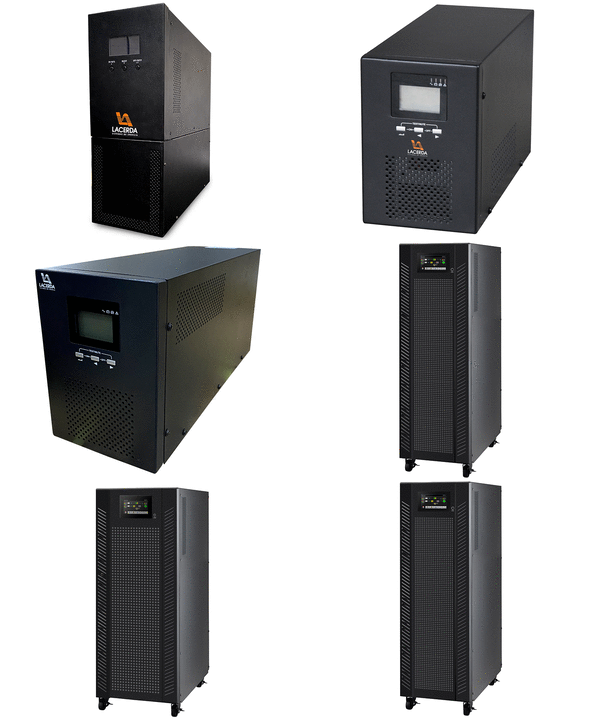
UPS ONLINE 10KVA- GRUPO DE PROCESSAMENTO DE ENERGIA E CONTROLE(GEPEC) UNIVERSIDADE FEDERAL CEARA-BRASIL
UPS SINGLE PHASE ONLINE 10KVA DESENVOLVIDO NO GEPEC GPEC- GRUPO DE PROCESSAMENTO DE ENERGIA E CONTROLE DA UNIVERSIDADE FEDERAL DE CEARÁ EM PARCERIA COM A MICROSOL.,TENHO ORGULHO E SATISFAÇÃO DE TER TRABALHADO EM VÁRIOS TRABALHOS COMO ENG.DE PESQUISA DA MICROSOL.
O Grupo de Processamento de Energia e Controle (GPEC), criado em 1995, é ligado ao Departamento de Engenharia Elétrica (DEE) da UFC e tem como objetivo a pesquisa e o desenvolvimento tecnológico em eletrônica de potência. O GPEC atua na proposição de soluções tecnológicas para os setores industriais e de serviço, portanto trabalha em parceria com a indústria nacional, empresas de energia elétrica e institutos de pesquisa no Brasil e no exterior. Os professores e pesquisadores do grupo têm tido atuação destacada no curso de graduação e no programa de pós-graduação em Engenharia Elétrica da UFC, contribuindo na formação e qualificação de profissionais para atuação em áreas como: Sistemas Elétricos de Potência, Eletrônica de Potência, Acionamento Industrial, Qualidade de Energia Elétrica e Aproveitamento de Fontes Renováveis de Energia.
WEBSITE DO GPEC : http://www.gpec.ufc.br/
UPS SINGLE PHASE 10KVA GRUPO DE PROCESSAMENTO DE ENERGIA E CONTROLE GEPEC FORTALEZA CEARA,UM DOS MAIORES GRUPOS DE PESQUISA DE ELETRÔNICA DE POTENCIA DO BRASIL,PESSOALMENTE ME SINTO MUITO FELIZ DE TER SER PARTE DA HISTORIA VIVA DO DESENVOLVIMENTO DA ELETRÔNICA DE POTENCIA NO BRASIL,MESMO QUE HOJE POR QUESTÕES ECONÔMICAS E POLITICAS QUASE TODOS OS EQUIPAMENTOS SÃO IMPORTADOS E NOSSO DEVER TER SEMPRE NOSSA TECNOLOGIA PRÓPRIA,O PROBLEMA FUNDAMENTAL NÃO E O PROJETO,O PROBLEMA FUNDAMENTAL E A PRODUÇÃO EM ESCALA UNIVERSAL PARA TER PREÇO E SER COMPETITIVOS NO MERCADO,NESTE REQUISITO CHINA ATUALMENTE DOMINA A PRODUÇÃO EM ALTÍSSIMA ESCALA O QUAL E UM GRANDE DESAFIO PARA TODOS.
POWER ELECTRONICS PROF. YONGSUG SUH -PART10-AC-DC CONVERTER 전력전자 및 실험 전북대학교 서용석 - CHONBUCK NATIONAL UNIVERSITY - KOREA OPEN COURSEWARE PART10-
POWER ELECTRONICS PROF. YONGSUG SUH - CHONBUCK NATIONAL
UNIVERSITY - KOREA OPEN COURSEWARE
PART10- AC-DC converter introduction to Switch-mode Inverter
domingo, 11 de fevereiro de 2018
Power electronics aspects for AC grid connected systems - a revision .-Wilson Komatsu- Escola Politécnica-UNIVERSIDADE DE SÃO PAULO BRASIL
Tese de Livre Docencia DocumentoTese de Livre Docencia
AutorKomatsu, Wilson (Catálogo USP)
Nome completoWilson Komatsu
E-mail E-mailUnidade da USP Escola Politécnica
Área do Conhecimento Eletrônica de Potência
Data de Defesa 2011-09-27
ImprentaSão Paulo, 2011
Banca examinadora Galvão, Luiz Cláudio Ribeiro (Presidente) Kaiser, Walter Kassick, Ênio Valmor Pomilio, José Antenor Suemitsu, Walter Issamu
Título em português
Aspectos de eletrônica de potência em sistemas ligados à rede de corrente alternada - uma revisão.Palavras-chave em português Eletrônica de potência
Resumo em português Vários equipamentos de eletrônica de potência são conectados à rede de corrente alternada (CA), para os mais diversos fins, como conversão de energia, filtragem de corrente e tensão, correção de reativos da rede CA etc. Este trabalho apresenta uma revisão não abrangente, refletindo a experiência do autor, sobre tais equipamentos. São discutidos aspectos de aplicações, modelamento de equipamentos e componentes, controle de conversores, implementação e testes. A abordagem é realizada com o uso de publicações do autor com seus associados, de modo que não se apresenta aqui proposta inédita, mas sim uma integração de conhecimento adquirido.
Título em inglês
Power electronics aspects for AC grid connected systems - a revision
.Palavras-chave em inglês Power electronics
Resumo em inglês Many power electronics equipment are connected to the alternating current (AC) grid in order to provide different functions, as energy conversion, current and voltage filtering, AC reactive power compensation etc. This work shows an abridged revision, reflecting author's experience, on such equipment. Application aspects, equipment and components modeling, converter control, implementation and tests are discussed. The approach is done using published works from the author with his associates, therefore no unpublished proposal is presented, but instead the acquired knowledge is exposed.
LINK ORIGINAL: http://www.teses.usp.br/teses/disponiveis/livredocencia/3/tde-21052012-181653/es.php
DOWNLOAD: http://www.teses.usp.br/teses/disponiveis/livredocencia/3/tde-21052012-181653/publico//TeseLivreDocenciaWilsonKomatsu.pdf
Wilson Komatsu currently works at the Departamento de Engenharia de Energia e Automação Elétricas (PEA) (POLI), University of São Paulo. Wilson does research in Electronic Engineering and Electrical Engineering. Their most recent publication is 'Digital Control for PLLs Based on Moving Average Filter: Analysis and Design in Discrete Domain.
sábado, 3 de fevereiro de 2018
A Novel Analog Circuit Design for Maximum Power Point Tracking of Photovoltaic Panels - Nesrine Mhiri,Abdulrahman Alahdal,Hamza Ghulman, and Anis Ammous
A Novel Analog Circuit Design for Maximum Power Point Tracking of Photovoltaic Panels Nesrine Mhiri,1 Abdulrahman Alahdal,2 Hamza Ghulman,2 and Anis Ammous1,2
1Power Electronics Group (PEG), National School of Engineers of Sfax, University of Sfax, Sfax, Tunisia 2DEE, Umm Al Qura University, Makkah, Saudi Arabia
Advances in Power Electronics Volume 2017 (2017), Article ID 9409801, 9 pages
https://doi.org/10.1155/2017/9409801
1. Introduction
Currently, the production of domestic and industrial energy is based, in large part, on a limited resource: oil. Oil sources are becomingmore andmore rare, while the energy demands of the world rise continually. Since this formof energy covers a large part of the current energy production, it is necessary to find another solution to take over.The imposed constraint is to use an energy source that is economical and less polluting because the protection of the environment has become an important point [1–3]. The search for alternative energy resources has therefore become a crucial issue these days. Many scientific researches have been carried out, not only in the field of nuclear energy production, but also in the sector of unlimited energy sources, such as wind power generation and energy transformation. In the latter case, the design, optimization, and realization of photovoltaic systems are topical issues since they lead to a better exploitation of solar energy [2]. These photovoltaic powers generating systems can be operated in different places: electrification of isolated sites, installation in buildings or direct connection to network of electricity, and so on. A major problem with PV systems is to realize transfer of maximum power from PV generator to load. For several years, manyMPPT controlmethods have been developed and implemented, like Fuzzy Logic Method [4–7], perturbation and observation (P&O) method [5, 6, 8], and Incremental Conductance (Inc.Con.) method [7, 9–11].These techniques are generally complex and expensive to implement [4, 9, 12]. They differ in several aspects like complexity, range of effectiveness, cost, convergence speed, implementation hardware, required sensors, and popularity, plus other respects. However, these techniques are digital implementation. Alternatively, the MPPT can be implemented by analog circuits [13–15]. The potential benefit from analog solution is that theMPPT can be integrated withDC-DCcontroller such that “plug and play” can be expected for many low power PV applications. In fact, integration of certain functions into a normal PWM controller chip is the most desirable way for special applications to reduce the implementation complexity and system cost. In this paper, a new analog MPPT technique suitable for PV system applications is presented and validated by simulations.
LINK ORIGINAL:https://www.hindawi.com/journals/ape/2017/9409801/
DOWNLOAD: http://downloads.hindawi.com/journals/ape/2017/9409801.pdf
quarta-feira, 31 de janeiro de 2018
Inductor Design Method of DCM Interleaved PFC Circuit for 6.6-kW On-board Charger Bong-Gi You*, Byoung-Kuk Lee* and Dong-Hee Kim - Department of Electrical and Computer Engineering, Sungkyunkwan University, Korea
Inductor Design Method of DCM Interleaved PFC Circuit for 6.6-kW On-board Charger Bong-Gi You*, Byoung-Kuk Lee* and Dong-Hee Kim
Corresponding Author: Department of Electrical Engineering, Chonnam National University, Korea. (kimdonghee@jnu.ac.kr) * Department of Electrical and Computer Engineering, Sungkyunkwan University, Korea. (bongary91@gmail.com, bkleeskku@skku.edu) Received: April 6, 2017; Accepted: July 17, 2017
Abstract – Because the on-board charger (OBC) is installed in electric vehicles (EVs), high power density is regarded as a key technology. Among components of the OBC, inductors occupy more than 30% of the total volume. Thus, it is important to reduce the volume and the weight of inductors while maintaining thermal stability. Discontinuous conduction mode (DCM) can satisfy these requirements; however, only a few studies have adopted the DCM operation for OBCs because of the large inductor current ripple. In this paper, a design process is proposed for application of the DCM operation to OBCs. In order to analyze the inductor losses accurately, a numerical formula for the inductor current ripple is deduced based on a detailed analysis. Two inductors are fabricated using several ferrite cores and powder cores taking into consideration the inductor size, inductor losses, and temperature rise. In order to verify the analysis and design process, experimental results are presented that show that the designed inductors satisfy the requirements of the OBCs
LINK VIEW FULL TEXT
http://www.jeet.or.kr/LTKPSWeb/pub/pubfpfile.aspx?ppseq=1896
sábado, 20 de janeiro de 2018
High Frequency Isolated Power Conversion from Medium Voltage AC to Low Voltage DC Shishuo Zhao - Virginia Polytechnic Institute and State
High Frequency Isolated Power Conversion from Medium Voltage AC to Low Voltage DC
Shishuo Zhao - Virginia Polytechnic Institute and State
Abstract
Modern data center power architecture developing trend is analyzed, efficiency improvement method is also discussed. Literature survey of high frequency isolated power conversion system which is also called solid state transformer is given including application, topology, device and magnetic transformer. Then developing trend of this research area is clearly shown following by research target. State of art wide band gap device including silicon carbide (SiC) and gallium nitride (GaN) devices are characterized and compared, final selection is made based on comparison result. Mostly used high frequency high power DC/DC converter topology dual active bridge (DAB) is introduced and compared with novel CLLC resonant converter in terms of switching loss and conduction loss point of view. CLLC holds ZVS capability over all load range and smaller turn off current value. This is beneficial for high frequency operation and taken as our candidate. Device loss breakdown of CLLC converter is also given in the end. Medium voltage high frequency transformer is the key element in terms of insulation safety, power density and efficiency. Firstly, two mostly used transformer structures are compared. Then transformer insulation requirement is referred for 4160 V application according to IEEE standard. Solid insulation material are also compared and selected. Material thickness and insulation distance are also determined. Insulation capability is preliminary verified in FEA electric field simulation. Thirdly two transformer magnetic loss model are introduced including core loss model and litz wire winding loss model. Transformer turn number is determined based on core loss and winding loss trade-off. Different core loss density and working frequency impact is carefully analyzed. Different materials show their best performance among different frequency range. Transformer prototype is developed following designed parameter. We test the developed 15 kW 500 kHz transformer under 4160 V dry type transformer IEEE Std. C57.12.01 standard, including basic lightning test, applied voltage test, partial discharge test. 500 kHz 15 kW CLLC converter gate drive is our design challenge in terms of symmetry propagation delay, cross talk phenomenon elimination and shoot through protection. Gate drive IC is carefully selected to achieve symmetrical propagation delay and high common mode dv/dt immunity. Zero turn off resistor is achieved with minimized gate loop inductance to prevent cross talk phenomenon. Desaturation protection is also employed to provide shoot through protection. Finally 15 kW 500 kHz CLLC resonant converter is developed based on 4160V 500 kHz transformer and tested up to full power level with 98% peak efficiency.
LINK WEB : https://vtechworks.lib.vt.edu/bitstream/handle/10919/74969/Zhao_S_T_2017.pdf?sequence=1
terça-feira, 16 de janeiro de 2018
Small-Signal Modeling and Controller Design of a Grid-Connected Inverter for Solid State Transformer-Bo-Gyeong Kim Department of Electrical and Computer Engineering ULSAN NATIONAL INSTITUTE OF SCIENCE AND TECHNOLOGY
Design of a Grid-Connected Inverter for Solid State Transformer -Bo-Gyeong Kim
Department of Electrical and Computer Engineering ULSAN NATIONAL INSTITUTE OF SCIENCE AND TECHNOLOGY
Abstract
A single-phase grid-connected inverter for solid state transformer (SST) is presented. This work is aimed at the modeling and the design of control schemes for the inverter. In this thesis, a small-signal model for the grid-connected inverter with modified bipolar pulse width modulation method is developed. Small-signal analysis allows to predict the stability and dynamics of the inverter. Based on theoretical analysis, controllers are designed to improve dynamics and to guarantee stability of the system. A high power factor and low harmonics are desirable in transmission system to improve the efficiency of the utility line. The current controller of the single-phase grid-connected inverter has sinusoidal reference to achieve power factor correction (PFC) and harmonics suppression. Proportional-integral (PI) scheme is widely used to control the power converter. The PI controller has the infinite gain at dc so it is suitable to track the dc reference. However, it is not good for tracking sinusoidal reference due to its finite gain at ac. The proportional-resonant (PR) controller which introduces large gain at specific frequency can track the sinusoidal reference without steady-state error but the error remains in step input response. The proportional-integral-resonant (PIR) controller has the advantage of both tracking the sinusoidal reference and removing the steady-state error for the step input. In this thesis, PIR controller is proposed for current control and design procedure for the PIR controller is presented. In addition, the voltage controller is needed to regulate the dc link voltage. The voltage controller is designed to improve the audio-susceptibility and the output impedance characteristics. The dynamics and stability of the inverter system is analyzed. The proposed small-signal model and controllers are verified by PSIM simulation and experiments.
LINK
http://ocean.kisti.re.kr/downfile/volume/kiee/DHJGII/2017/v66n1/DHJGII_2017_v66n1_40.pdf
LINK
http://www.mediafire.com/file/jbms2kqjx158cb9/SMALL_MODELING_GRID_CONVERTER.pdf
domingo, 14 de janeiro de 2018
EE640 - ELETRÔNICA BÁSICA II PROF ELNATAN CHAGAS FERREIRA FACULDADE DE ENGENHARIA ELÉTRICA E COMPUTAÇÃO-FEEC-UNICAMP-BRASIL
EE640 - ELETRÔNICA BÁSICA II
Esta disciplina tem por objetivo o estudo de circuitos eletrônicos, como sejam amplificadores a transistores, circuitos com amplificadores operacionais, realimentação, resposta freqüência, etc. No final da disciplina os alunos devem ser capazes de dimensionar, projetar e implementar circuitos eletrônicos baseados nos circuitos estudados na cadeira.
Pré-Requisitos: EE410 EE530/ EE530 F589. Os alunos devem ter conhecimentos sólidos dos seguintes tópicos: componentes eletrônicos básicos (resistências, condesadores e bobinas), semicondutores (diodos, transistores TBJ e FET), modelos de transistores bipolares e MOSFET, análise básica de circuitos (Lei das Malhas, lei dos nós, etc.) e transformada de Laplace.
EMENTA DETALHADA
Para uma melhor visualização do andamento desta disciplina mostramos abaixo, com maior detalhe, os assuntos abordados, com as respectivas horas e referência bibliográfica. Tópicos NºHoras Bib.
1)Revisão dos Modelos Diodos, transistores BJT e FET 4 [2]
2)Análise de circuitos com um transistor (BJT) e FET Polarização DC e Análise em Configurações Básicas 8 [2]
3)Análise de circuitos com dois transistores (BJT) e FET Conexões em cascata, Cascode, Darlinton, Quasi-Darlington, Par realimentado, Par Diferencial, Espelho de corrente. 8 [2]
4)Resposta em freqüência Resposta em freqüência de um amp. de um estágio, Resposta em freqüência de um amp. de múltiplos estágios. 8 [4]
5)Amplificadores Operacionais Tipos de Opamp, Estrutura básica de um Opamp FV, Opamp básicos, Opamp ideal e real, Característica de Opamp., Modelos. 10 [4]
6)Circuitos com Amplificadores Operacionais Amp. não Inversor, Amp. Inversor, Amp. Diferença, Amp Somador, Integrador, Diferenciador, Aplicações não Lineares. 6 [4]
7)Realimentação Equação da realimentação ideal, Efeitos da realimentação, Configurações, Configurações práticas e efeito de carregamento, Realimentação em um simples estágio. 8 [4]
8)Circuitos Integrados Processos básicos em fabricação de CI, fabricação de circuitos em tecnologia bipolar, Dispositivos ativos em tecnologia bipolar, componentes passivos em tecnologia bipolar, fabricação de circuitos em tecnologia MOS, Dispositivos ativos em tecnologia MOS, componentes passivos em tecnologia MOS.
DOWNLOADS E AULAS
| Aula 1 | Aula 2 | Aula 3 | Aula 4 |
| Aula 5 | Aula 6 | Aula 7 | Aula 8 |
| Aula 9 | Aula 10 | Aula 11 | Aula 12 |
| Aula 13 | Aula 14 | Aula 15 | Aula 16 |
| Aula 17 | Aula 18 | Aula 19 | Aula 20 |
| Aula 21 | Aula 22 | Aula 23 | Aula 24* |
Physics, UFC, 1981, MSc. In Electrical Engineering, UNICAMP, 1984. Ph.D. In Electrical Engineering, UNICAMP, 1991. Livre Docência In Electronic Instrumentation, UNICAMP, 2001. Professor since 1985 in Microelectronics and Electronic Department -DEMIC. Responsible for Department's Laboratory of Sensors and Instrumentation.
LINK ORIGINAL
http://www.demic.fee.unicamp.br/~elnatan/index.html
LINK COMPLETO DE ARCHIVOS CLASES Y EXAMENES
http://www.demic.fee.unicamp.br/~elnatan/ee640/
sábado, 6 de janeiro de 2018
High Efficiency Power Converter for Low Voltage High Power Applications - Morten Nymand - DTU Electrical Engineering Technical University of Denmark
Nymand
High Efficiency Power Converter
for Low Voltage High Power Applications
Author:Morten Nymand
Supervisor:Michael A. E. Andersen
DTU Electrical Engineering Technical University of Denmark Ørsteds Plads Building 349 DK-2800 Kgs. Lyngby Denmark
Publishing date: January 2010
Classification: Public Edition: 1st Edition
Note: This thesis is submitted in partial fulfillment of the requirements for obtaining the PhD degree at the Technical University of Denmark. Copyright: Morten Nymand, 2010
Abstract
The topic of this thesis is the design of high efficiency power electronic dc-to-dc converters for high-power, low-input-voltage to high-output-voltage applications. These converters are increasingly required for emerging sustainable energy systems such as fuel cell, battery or photo voltaic based energy systems.
Applications include systems for emergency power back-up (UPS), de-centralized combined heat and power systems, traction applications such as hybrid electrical vehicles, forklift trucks and special applications such as low emission power generation for truck and ship containers, and remote power generation for light towers, camper vans, boats, beacons, and buoys etc.
In chapter 2, a review of current state-of-the-art is presented. The best performing converters achieve moderately high peak efficiencies at high input voltage and medium power level. However, system dimensioning and cost are often determined by the performance at the system worst case operating point which is usually at minimum input voltage and maximum power. Except for the non-regulating V6 converters, all published solutions exhibit a very significant drop in conversion efficiency at minimum input voltage and maximum output power.
In chapter 3, a detailed analysis of dominant loss factors in high power converters for low voltage applications is presented. The analysis concludes that:
Power transformers for low voltage high power, if properly designed, will have extremely low leakage inductance.
If optimally designed, boost converters will be much more efficient than comparable buck type converters for high power low voltage applications. The use of voltage clamp circuits to protect primary switches in boost converters is no longer needed for device protection. On the other hand, they will dramatically increase power losses. Moreover, if a converter is properly designed, primary side voltage clamp circuits will not even work in low voltage high power converters.
Very high conversion efficiency can be achieved. Peak efficiency of 98% and worst case minimum efficiency of 96.8% are demonstrated on a 1.5 kW converter.
In chapter 4, the ability to - and challenges involved in - scaling of power converters for low voltage applications in the power range of 1-10 kW are analyzed. The analysis concludes that power MOSFETs needs to be paralleled extensively to scale power level to 10 kW. Maintaining fast current switching and reliable current sharing is essential. Further, the high ac-current carrying loop on the converter primary side will become increasingly difficult to scale due to fundamental issues such as physical size of components and penetration depth in copper.
Finally in chapter 5, a new method for partial paralleling of multiple primary power stages in isolated boost converters is presented. Maximum benefit of scaling in terms of higher efficiency and lower cost is preserved by only paralleling primary switches and the critical high ac-current loop. Dynamic current sharing is inherently guaranteed between parallel power stages. The principle can be applied to all isolated boost type converters and, in principle, an unlimited number of power stages can be paralleled. Feasibility and operation of the new topology are demonstrated on a dual 3 kW and a quad 10 kW prototype converter. Measured peak efficiency is 98.2% and worst case minimum efficiency is between 96.5% and 96.9%.
LINK
http://orbit.dtu.dk/fedora/objects/orbit:82166/datastreams/file_4650370/content
Author:Morten Nymand
Supervisor:Michael A. E. Andersen
DTU Electrical Engineering Technical University of Denmark Ørsteds Plads Building 349 DK-2800 Kgs. Lyngby Denmark
Publishing date: January 2010
Classification: Public Edition: 1st Edition
Note: This thesis is submitted in partial fulfillment of the requirements for obtaining the PhD degree at the Technical University of Denmark. Copyright: Morten Nymand, 2010
Abstract
The topic of this thesis is the design of high efficiency power electronic dc-to-dc converters for high-power, low-input-voltage to high-output-voltage applications. These converters are increasingly required for emerging sustainable energy systems such as fuel cell, battery or photo voltaic based energy systems.
Applications include systems for emergency power back-up (UPS), de-centralized combined heat and power systems, traction applications such as hybrid electrical vehicles, forklift trucks and special applications such as low emission power generation for truck and ship containers, and remote power generation for light towers, camper vans, boats, beacons, and buoys etc.
In chapter 2, a review of current state-of-the-art is presented. The best performing converters achieve moderately high peak efficiencies at high input voltage and medium power level. However, system dimensioning and cost are often determined by the performance at the system worst case operating point which is usually at minimum input voltage and maximum power. Except for the non-regulating V6 converters, all published solutions exhibit a very significant drop in conversion efficiency at minimum input voltage and maximum output power.
In chapter 3, a detailed analysis of dominant loss factors in high power converters for low voltage applications is presented. The analysis concludes that:
Power transformers for low voltage high power, if properly designed, will have extremely low leakage inductance.
If optimally designed, boost converters will be much more efficient than comparable buck type converters for high power low voltage applications. The use of voltage clamp circuits to protect primary switches in boost converters is no longer needed for device protection. On the other hand, they will dramatically increase power losses. Moreover, if a converter is properly designed, primary side voltage clamp circuits will not even work in low voltage high power converters.
Very high conversion efficiency can be achieved. Peak efficiency of 98% and worst case minimum efficiency of 96.8% are demonstrated on a 1.5 kW converter.
In chapter 4, the ability to - and challenges involved in - scaling of power converters for low voltage applications in the power range of 1-10 kW are analyzed. The analysis concludes that power MOSFETs needs to be paralleled extensively to scale power level to 10 kW. Maintaining fast current switching and reliable current sharing is essential. Further, the high ac-current carrying loop on the converter primary side will become increasingly difficult to scale due to fundamental issues such as physical size of components and penetration depth in copper.
Finally in chapter 5, a new method for partial paralleling of multiple primary power stages in isolated boost converters is presented. Maximum benefit of scaling in terms of higher efficiency and lower cost is preserved by only paralleling primary switches and the critical high ac-current loop. Dynamic current sharing is inherently guaranteed between parallel power stages. The principle can be applied to all isolated boost type converters and, in principle, an unlimited number of power stages can be paralleled. Feasibility and operation of the new topology are demonstrated on a dual 3 kW and a quad 10 kW prototype converter. Measured peak efficiency is 98.2% and worst case minimum efficiency is between 96.5% and 96.9%.
LINK
http://orbit.dtu.dk/fedora/objects/orbit:82166/datastreams/file_4650370/content
segunda-feira, 1 de janeiro de 2018
Laboratório de Microrredes Inteligentes na UNIVERSIDADE FEDERAL DE SANTA CATARINA-BRASIL (uGridLab)
VÍDEO INSTITUCIONAL
Laboratório de Microrredes Inteligentes na UFSC (uGridLab)-UNIVERSIDADE FEDERAL DE SANTA CATARINA ,NOVAS TECNOLOGIAS,NOVOS PARADIGMAS .
LINK DO LABORATORIO
http://ugridlab.paginas.ufsc.br/
sexta-feira, 29 de dezembro de 2017
Linhas de Transmisão - Apresentação da Obra LT CC 800kV XINGU - ESTREITO (BMTE)-BRASIL
Linha de Transmissão (LT) Corrente Contínua (CC) +800 kV Xing/Estreito e de suas Instalações Associadas. Esta LT, com extensão de 2.086,9 km, interceptará quatro estados – Pará, Tocantins, Goiás e Minas Gerais. A LT terá início na Subestação (SE) Xingu, localizada a aproximadamente 17 km da UHE Belo Monte, no município de Anapu-PA, seguindo até a SE Estreito, localizada no município de Ibiraci-MG. Considerando a extensão e importância do empreendimento e buscando otimizar o planejamento e a execução das obras, a LT (CC) +800 kV Xingu/Estreito foi dividida em 8 trechos, cada um com aproximadamente 260 km. Um grupo de quatro construtoras (EPCistas) será responsável pelos respectivos trechos contratados, possibilitando, dessa forma, um maior controle por parte da equipe da SPE S.A. Um dos Eletrodos será instalado no município de Altinópolis, SP, e será interligado à Estação Conversora (EC) Estreito por meio da Linha de Eletrodo, que interceptará 5 municípios: Ibiraci e Claraval, no Estado de Minas Gerais, e Franca, Patrocínio Paulista e Altinópolis, no Estado de São Paulo. Já o Eletrodo que interligará a EC Xingu será instalado em Anapu, PA, com a Linha de Eletrodo sendo instalada apenas neste município.
LOCALIZAÇÃO DO EMPREENDIMENTO
O Mapa de Localização apresenta a localização geográfica do empreendimento, nos Estados de Pará, Tocantins, Goiás, Minas Gerais e São Paulo.
OBJETIVOS E JUSTIFICATIVAS DO EMPREENDIMENTO A Usina Hidrelétrica de Belo Monte, em construção na região de Altamira e Vitória do Xingu, no Pará, na sua configuração final, terá capacidade instalada de 11.233 MW, sendo 11.000 MW na casa de força principal e 233 MW na casa de força secundária. Por se tratar de uma usina hidrelétrica com grande capacidade instalada, com potencial para gerar muita energia, parte da produção durante os meses chuvosos será enviada para os estados das regiões Sudeste e Nordeste, principais consumidores do país. A fim de facilitar e otimizar o escoamento da energia produzida, foram comparadas diversas tecnologias existentes. Por fim, optou-se pelo sistema de Corrente Contínua de ±800 kV para reforço à interligação Norte – Sudeste, além de um sistema em corrente alternada de 500 kV como reforço às interligações Norte - Nordeste – Sudeste. As Instalações Associadas da LT (CC) +800 kV Xingu/Estreito incluem as Estações Conversoras (EC) Xingu e Estreito, dois Eletrodos de Terra, com suas respectivas Linhas de Eletrodo, com extensões de aproximadamente 46 km (Linha de Eletrodo Xingu) e 74 km (Linha de Eletrodo Estreito), para interligação desses eletrodos às ECs, e sete Estações Repetidoras (ERs).
VER RELATORIO COMPLETO NO SEGUINTE LINK ORIGINAL
http://www.bmte.com.br/wp-content/uploads/2016/06/RIMA.pdf
quinta-feira, 28 de dezembro de 2017
10th SEMINAR ON POWER ELECTRONICS AND CONTROL-SANTA MARIA RS - BRAZIL
SEPOC 2017 is the 10th edition of the Seminar on Power Electronics and Control and this year the conference will be held with the IEEE seal. The meeting will take place at the Technology Center of the Federal University of Santa Maria and is organized by the IEEE Chapters and Student Branch.
The seminar’s objective is to provide interaction among academia and industry to discuss the latest cutting-edge technologies on Power Electronics and Control and their applications. In 2017, the conference is themed on distributed power generation.
Plenary Session 03: Reliability of Power Electronic Systems – Challenges and State-of-the-Art
Speaker: Huai Wang - Aalborg University, Denmark Huai Wang is currently an Associate Professor and a Research Thrust Leader with the Center of Reliable Power Electronics (CORPE), Aalborg University, Denmark.
His research addresses the fundamental challenges in modelling and validation of power electronic component failure mechanisms, and application issues in system-level predictability, condition monitoring, circuit architecture, and robustness design. Prof. Wang is a lecturer of a 2-day industry/PhD course on Capacitors in Power Electronics Applications, and a 3-day industry/PhD course on Reliability of Power Electronic Systems held annually at Aalborg University. He is an invited speaker at the European Center for Power Electronics (ECPE) workshops, and a tutorial lecturer at leading power electronics conferences (ECCE, APEC, EPE, PCIM, IECON, etc.). He has co-edited a book on Reliability of Power Electronic Converter Systems in 2015, filed four patents in capacitive DC-link inventions, and contributed a few concept papers in the area of power electronics reliability. Prof. Wang received his PhD degree from the City University of Hong Kong, Hong Kong, and Bachelor degree from Huazhong University of Science and Technology, Wuhan, China. He was a visiting scientist with the ETH Zurich, Switzerland, from August to September 2014, and with the Massachusetts Institute of Technology (MIT), Cambridge, MA, USA, from September to November 2013. He was with the ABB Corporate Research Center, Baden, Switzerland, in 2009. He received the IEEE PELS Richard M. Bass Outstanding Young Power Electronics Engineer Award, in 2016, for the contribution to the reliability of power electronic conversion systems. He serves as an Associate Editor of IEEE Journal of Emerging and Selected Topics in Power Electronics and IEEE Transactions on Power Electronics.
LINK : http://farol.ufsm.br/transmissao/transmissao-ao-vivo-sepoc-24102017-09h
quarta-feira, 27 de dezembro de 2017
Single phase transformerless inverter topologies for grid-tied photovoltaic system: A review - Monirul Islam a,Saad Mekhilef ,Mahamudul Hasan
Single phase transformerless inverter topologies for grid-tied photovoltaic system: A review Monirul Islam a,Saad Mekhilef ,Mahamudul Hasan
Power Electronics and Renewable Energy Research Laboratory (PEARL), Department of Electrical Engineering, Faculty of Engineering, University of Malaya, Kuala Lumpur 50603, Malaysia
Department of Mechanical Engineering, University of Malaya, Kuala Lumpur 50603, Malaysia
Abstract :
Grid-tied inverters are the key components of distributed generation system because of their function as an effective interface between renewable energy sources and utility. Recently, there has been an increasing interest in the use of transformerless inverter for low-voltage single-phase grid-tied photovoltaic (PV) system due to higher efficiency, lower cost, smaller size and weight when compared to the ones with transformer. However, the leakage current issues of transformerless inverter, which depends on the topology structure and modulation scheme, have to be addressed very carefully. This review focuses on the transformerless topologies, which are classified into three basic groups based on the decoupling method and leakage current characteristics. Different topologies under the three classes are presented, compared and evaluated based on leakage current, component ratings, advantages, and disadvantages. An examination of demand for the inverter, the utility grid, and the PV module are presented. A performance comparison in MATLAB/Simulink environment is done among different topologies. Also an analysis has been presented to select a better topology. Finally, based on the analysis and simulation results, a comparison table has been presented. Furthermore, some important experimental parameters have been summarized.
LINK
http://citeseerx.ist.psu.edu/viewdoc/download?doi=10.1.1.702.4372&rep=rep1&type=pdf
sábado, 23 de dezembro de 2017
H6-type transformerless single-phase inverter for grid-tied photovoltaic system -Monirul Islam, Saad Mekhilef ✉ Power Electronics and Renewable Energy Research Laboratory (PEARL), Department of Electrical Engineering, University of Malaya.
H6-type transformerless single-phase inverter for grid-tied photovoltaic system ISSN 1755-4535
Received on 20th April 2014 Accepted on 7th October 2014 doi: 10.1049/iet-pel.2014.0251
www.ietdl.org
Monirul Islam, Saad Mekhilef ✉ Power Electronics and Renewable Energy Research Laboratory (PEARL), Department of Electrical Engineering, University of Malaya, Kuala Lumpur 50603, Malaysia ✉ E-mail: saad@um.edu.my
Abstract:
There has been an increasing interest in transformerless inverter for grid-tied photovoltaic (PV) system because of the benefits of lower cost, smaller volume as well as higher efficiency compared with the ones with transformer. However, one of the technical challenges of the transformerless inverter is the safety issue of leakage current which needs to be addressed carefully. In addition, according to the international regulations, transformerless inverter should be capable of handling a certain amount of reactive power. In this study, a new H6-type transformerless inverter for grid-tied PV system is proposed that can eliminate the threat of leakage current. The proposed topology has also the capability to inject reactive power into the utility grid. Three-level output voltage employing unipolar sinusoidal pulsewidth modulation can be achieved with the proposed topology. The proposed topology structure and detail operation principle with reactive power control are investigated. The relationship among the existing topologies and their reactive power control capability are also discussed. The proposed topology is simulated in MATLAB/Simulink software to initially verify the accuracy of theoretical explanations. Finally, a universal prototype rated 1 kW has been built and tested. The experimental results validate the theoretical analysis and simulation results.
VIEW COMPLETE TEXT:
https://pdfs.semanticscholar.org/43da/3251d204cbce6582f68347422b84d95e4a1f.pdf
domingo, 10 de dezembro de 2017
High-Frequency Transformer Design for Solid- State Transformers in Electric Power Distribution Systems Roderick Javier Garcia Montoya University of Arkansas, Fayetteville
High-Frequency Transformer Design for Solid-State Transformers in Electric Power Distribution Systems
ABSTRACT
A thesis submitted in partial fulfillment of the requirements for the degree of Master of Science in Electrical Engineering by Roderick Javier Garcia Montoya Universidad Tecnológica de Panamá Bachelor of Science in Electromechanical Engineering, 2011
December 2015 University of Arkansas This thesis is approved for recommendation to the Graduate Council. ABSTRACT The objective of this thesis is to present a high- or medium-frequency transformer design methodology for Solid-State Transformer (SST) applications. SSTs have been proposed as a replacement of the traditional 50/60 Hz transformer in applications demanding high-power density. Moreover, due to the high penetration of distributed generation, DC grids, energy storage systems, and sensitive loads, SSTs have been considered as an enabling technology for envisioned future energy systems. These applications demand additional functionalities that may not be achieved with traditional transformers. For example, active power flow control, harmonic suppression, voltage regulation, voltage sag compensation, and reduced size and volume. In this thesis, SST topologies are evaluated in order to determine their impact upon the transformer design. In addition, design considerations for core and wire selections, isolation requirements, and different transformer structures are investigated. As a result, the proposed transformer design methodology accounts for leakage inductance requirements for optimal power transfer, high-frequency effects in the transformer core and windings, and a flux density optimization to maximize transformer’s efficiency. The design procedure has been implemented in MATLAB® as an interactive tool for designing high-frequency transformers.
LINK
http://scholarworks.uark.edu/cgi/viewcontent.cgi?article=2381&context=etd
sábado, 9 de dezembro de 2017
Design and Development of High-voltage and High-frequency Transformer for Solid-state Transformer* Park Siho - Kyungpook National University Daegu, Korea
Design and Development of High-voltage and High-frequency Transformer for Solid-state Transformer* Park Siho School of Architectural, Civil, Environmental, and Energy Engineering
Graduate School, Kyungpook National University Daegu, Korea
(Supervised by Professor Cha Honnyong)
(Abstract)
In this paper, design guide of high-voltage isolated high-frequency transformer is proposed. Since a potential difference of up to 20 kV occurs at both ends of a transformer constituting a 3-port 3-level NPC based dual half-bridge DAB converter of solid-state transformer, it is necessary to design a transformer capable of 30 kV insulation considering margin. In order to insulate a voltage of 30 kV with air only, a very long distance between the primary and secondary wire of the transformer must be used. Therefore, bobbins made of Teflon resin and Polycarbonate were fabricated and insulation was obtained. To reduce the insulation parameter, core was connected to output neutral point terminal. The bobbin consists of an inner bobbin, an outer bobbin, a guard, and is designed to have sufficient dielectric strength. Through the simulation verification, only the primary wire portion was molded to remove the dielectric breakdown element generated at the portion where the outer bobbin and the guard contact with each other. A prototype transformer was built, completed operation verification and passed 30kV withstand voltage test. In the case of temperature test, there is no enough air layer to allow heat to escape from the secondary wire. Therefore, a high number of temperatures are measured, but this can be solved by turning the fan on.
Seminário Científico de Sistemas de Eletrônica de Potência – SCSEP 2017 – nos dias 13 e 14 de dezembro, no Auditório de Engenharia Elétrica no Centro Tecnológico (CTC) da UFSC.
O Instituto de Eletrônica de Potência (INEP) promoverá o terceiro Seminário Científico de Sistemas de Eletrônica de Potência – SCSEP 2017, evento que ocorrerá nos dias 13 e 14 de dezembro de 2017 no Auditório Luiz Antonio Teixeira, localizado no prédio da Engenharia Elétrica da UFSC, Florianópolis e será organizado por comissão local. O seminário está programado para receber aproximadamente 100 pessoas, entre alunos e professores da instituição e de outras, assim como profissionais da área que atuam nos setores público e privado. O evento tem como objetivo apresentar e divulgar os últimos avanços da área por meio da ação de alunos e pesquisadores do Instituto, incluindo pós-doutorandos, doutorandos, mestrandos, alunos de iniciação científica e tecnológica e em conclusão de curso de graduação. Tais trabalhos estão sendo desenvolvidos no INEP e se encontram em estágio avançado, representando possíveis soluções para a indústria e possibilitando, assim, a interação entre as partes. No evento serão realizadas também palestras e debates com convidados especialistas da área, com a finalidade de discutir as tendências e demandas atuais para a área de Eletrônica de Potência, bem como suas perspectivas futuras.
WEBSITE: http://scsep.inep.ufsc.br/
http://scsep.inep.ufsc.br/wp-content/uploads/2015/09/Revista_SCSEP_2017.pdf
sexta-feira, 8 de dezembro de 2017
quarta-feira, 6 de dezembro de 2017
Doctoral Thesis A Study on High Efficiency Bidirectional Grid-tied Converters -Sung-Ho Lee (이 성 호) Department of Electrical Engineering Pohang University of Science and Technology
Doctoral Thesis
A Study on High Efficiency Bidirectional Grid-tied Converters Sung-Ho Lee (이 성 호)
Department of Electrical Engineering Pohang University of Science and Technology 2016
This thesis presents three high efficiency grid-tied converter topologies and their respective control algorithms. These converters are applicable to various industrial fields such as energy storage systems (ESS), renewable energy systems, uninterruptible power supply (UPS) systems, and electric vehicles (EV). First, a high efficiency bidirectional grid-tied flyback converter that uses a single power conversion technique and a control system for it are introduced. The proposed converter consists of a bidirectional flyback dc-dc converter and an unfolding circuit. Due to its switching control strategy, the proposed converter performs bidirectional power conversion between the energy storage device and the grid through only single step. From the model analysis, the inherent dynamic characteristics are figured out. Based on the analysis, a control system is developed, which consists of a linear feedback controller with a low pass filter, a repetitive controller, and a feed-forward controller; this overcomes the constrains caused by a right-half-plane zero and a filter resonance and makes the proposed converter achieve the desired control performances and stability. In conclusion, the proposed converter can obtain high efficiency using a single power conversion technique, and the developed control system makes the proposed converter feasible. Second, a high efficiency single-phase bidirectional inverter for a PV energy system integrated with an energy storage system. The proposed single-phase inverter is developed using the transformerless system configuration so that it provides high power conversion efficiency, excellent power density, and low production cost. Using its circuit structure and switching operation, the proposed inverter can suppress the ground leakage current which is considered to be one of the most important design parameters in a transformerless PV system. Therefore, the proposed inverter gives the feasibility for the transforemrless system configuration in a PV energy system integrated with an energy storage system and enhances the overall performance of the bidirectional power converter system. The third is a novel high efficiency three-phase bidirectional grid-tied converter with high power density for high power applications. The proposed converter is composed of the threelevel dc-dc converter and the modified three-phase T-type three-level inverter. The threelevel converter circuit configuration gives smaller passive component size and lower switch voltage stress compared to other two-level grid-tied converters. In addition, due to its novel circuit structure, the proposed converter can use the active and passive components for only two phases of the grid in the inverter stage and eliminate the leakage current problem. Thus, because the proposed converter enables to not only decrease the number of components but also make the transformerless configuration feasible, it provides higher efficiency and higher power density compared to other high power grid-tied converters. All proposed converters are analyzed theoretically, and implemented practically. to evaluate their performance. Finally, the experimental results show that the proposed converters improve overall performance such as high power conversion efficiency, power density, and production cost with satisfying the standards for the grid regulations.
sexta-feira, 24 de novembro de 2017
9° SENSE - Seminário Nacional de Segurança e Saúde no Setor Elétrico Brasileiro
22, 23 e 24 novembro 2017 8h00 às 17h00 auditório do Instituto de Energia e Ambiente - IEE/USP - Av. Prof. Luciano Gualberto, 1.289 - Cidade Universitária, Butantã, São Paulo
Programação e inscrições em http://www.sense.funcoge.org.br Alinhada ao seu conceito estratégico de agregar conhecimento, a Fundação COGE - FUNCOGE, em conjunto com o Instituto de Energia e Ambiente da Universidade de São Paulo - IEE/USP e o Sindicato da Indústria da Energia no Estado de São Paulo - SINDIENERGIA, promoverá o 9° SENSE. São objetivos do evento: a) Congregar os profissionais da área de SSTQV - Segurança e Saúde no Trabalho e Qualidade de Vida das empresas do Setor Energético, visando o intercâmbio de experiências, o relacionamento, o convívio e a colaboração entre eles; b) Incentivar a produção de estudos e trabalhos focando a prevenção de acidentes, a promoção da saúde e qualidade de vida dos trabalhadores; c) Divulgar e discutis as alterações mais recentes da legislação pertinente a SST, de forma a auxiliar as empresas e seus profissionais na sua implementação; d) Apresentar as novidades no que se refere a EPI - Equipamentos de Proteção Individual, permitindo aos profissionais de SSTQV a discussão junto aos fornecedores.
Complementarmente, o evento pretende que os participantes conheçam o Laboratório de Ensaios de Vestimentas - LEVe/IEE/USP, inaugurado no final de 2016, que coloca o Brasil no seleto grupo de países com capacidade tecnológica para a realização de ensaios em vestimentas FR e EPI, de vital importância para a proteção dos trabalhadores do setor elétrico brasileiro.
LINK
http://www.sense.funcoge.org.br/
Assinar:
Postagens (Atom)


