
AUTOR DO BLOG ENG.ARMANDO CAVERO MIRANDA SÃO PAULO BRASIL

.gif)
“GRAÇAS A DEUS PELA VIDA,PELA MINHA FAMÍLIA,PELO TRABALHO.PELO PÃO DE CADA DIA,POR NOS PROTEGER DO MAL”
“SE SEUS PROJETOS FOREM PARA UM ANO,SEMEIE O GRÂO.SE FOREM PARA DEZ ANOS,PLANTE UMA ÁRVORE.SE FOREM PARA CEM ANOS,EDUQUE O POVO”

https://picasion.com/

sábado, 10 de setembro de 2016
Circuitos Elétricos - Aula 13 - Redes de 1ª Ordem - Parte 1 - Professor ministrante: Leopoldo R. Yoshioka

INDUCTIVE POWER TRANSFER TECHNOLOGY FOR MOBILE BATTERY CHARGER by SATISH ROUSHAN. Department of Electrical Engineering National Institute of Technology Rourkela- INDIA-2014


INDUCTIVE POWER TRANSFER TECHNOLOGY FOR MOBILE BATTERY CHARGER
A Thesis presented in partial fulfillment of the exigency for the degree of Bachelor of Technology in “Electrical Engineering”
By SATISH ROUSHAN
Under guidance of Prof. SUSOVAN SAMANTA
ABSTRACT
Inductive power transfer (IPT) is an application of electromagnetic induction principle. Since electromagnetic induction phenomena is directly proportional to the operating frequency, so as we increase the operating frequency, amount of energy transfer from one coil to another coil will also increase. As our power supply frequency is 50Hz so at this frequency, amount of energy transfer from one coil to another coil will be very less. In this thesis it is shown that, to transfer maximum amount of energy from one coil to another coil, it is necessary to use IPT at high frequency. At high frequency skin effect is more pronounced but there is a resonant frequency where overall efficiency is more in spite skin effect. To increase the power factor of IPT circuit compensated capacitor has used. There are four types of compensated topology but to use the IPT circuit in mobile battery charger primary-series-secondary-parallel (P-S-S-P) is more useful.
LINK ORIGINAL EN LA WEB
http://ethesis.nitrkl.ac.in/6417/1/E-85.pdf
sexta-feira, 9 de setembro de 2016
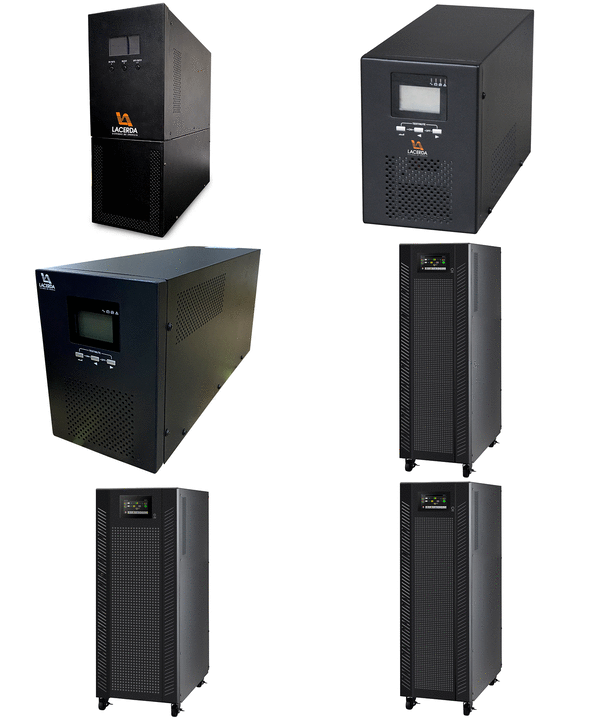
Lançamento da nova família de nobreaks senoidais Smart-UPS BR

A qualidade da energia elétrica brasileira em geral tem melhorado nos últimos anos no que tange aos indicadores de continuidade descritos no módulo 8 do PRODIST (Procedimentos de Distribuição de Energia Elétrica no Sistema Elétrico Nacional), porém mesmo com a modernização das redes de distribuição, as concessionárias necessitam investir na melhoria da gestão. Segundo a ANEEL, a média dos indicadores DEC (número de horas, em média, que o consumidor fica sem energia elétrica no ano) e FEC (quantas vezes em média houve interrupção no fornecimento de energia) de 2015 ficaram, respectivamente, em 18 horas e 35 minutos e 9,86 vezes. O valor do FEC diminuiu em relação ao ano passado e apresenta um padrão de queda desde 2010. Já o DEC, que também estava em queda, aumentou se comparado com o ano de 2014. Ou seja, os consumidores em média ficaram mais tempo sem energia elétrica.

Vislumbrando o aumento crescente do mercado de médios e pequenos servidores, além das aplicações de TI em indústrias, equipamentos médicos, circuitos CFTV, pontos de vendas e caixas eletrônicos, a APC by Schneider Electric está lançando a nova família de nobreaks Smart-UPS BR. Serão lançados cinco novos produtos com potência de 2200W e 3000W e tensão de alimentação bivolt e monovolt . Esta nova linha de nobreaks foi totalmente desenvolvida no Brasil pelo centro de P&D da Schneider Electric e atende às necessidades e particularidades do mercado brasileiro, com a confiabilidade lendária e tecnologia da APC by Schneider Electric. LINK ARTIGO COMPLETO ORIGINAL NA WEB
http://blog-br.schneider-electric.com/inovacao/2016/09/09/lancamento-nobreaks-senoidais-smart-ups/
Electromagnetism Sejong University PROF. YONGHO SEO PhD. Associate Professor - 전자기학 세종대학교 서용호


Electromagnetism Sejong University PROF. YONGHO SEO - 전자기학 세종대학교 서용호
Yongho Seo, PhD. Associate Professor
LINK FULL COURSE ELECTROMAGNETISM
http://home.sejong.ac.kr/~yseo/
Personal Date
Name, Family name: Seo
Given name: Yongho
Sex: Male
Nationality: Korean (ROK)
Office (mailing) address: 98 Gunja-dong, Gwangjin-gu, Sejong Univ. Choongmu-kwan room 816,
Seoul 143-747, South Korea
Tel: 82-2-3408-3689
E-mail: yseo@sejong.ac.kr
Education
1989-1993 : B.S. Department of Physics, Sogang University, Seoul, Korea, obtained in Feb. 1993
1993-1995 : M.S. Department of Physics, Seoul National University, obtained in Feb. 1995
1997-2000 : Ph.D Department of Physics, Seoul National University, obtained in Feb. 2000
Ph. D thesis "Study of Adsorption and Wetting using Quartz Crystal Microbalance"
Employment history
1994-1995: Teaching Assistant, Department of Physics, Seoul National University.
1995-1997: Research Assistant, Department of Physics, Seoul National University.
1997-1999: Teaching Assistant, Department of Physics, Seoul National University.
2000- 10/2002: Researcher, Center for Near-field Atom-Photon Technology, Seoul National University.
2002.10-2004.05: Research Associate in Physics department in University of Virginia.
2004.06-2005.05: Postdoc. Dept. Physics and Astronomy, Northwestern University.
2005.07-2006.02: Research staff, Samsung Advanced Institute of Technology.
2006.03-2010.02: Assistant Professor, Dept. Nano-engineering, Sejong University.
2010.03-present: Associate Professor, Dept. Nano-engineering, Sejong University.
Electricité statique -- Risques d'explosion et mesures de protection – Suva – SuvaPr

http://www.suva.ch/arRPm9q - Des expériences de laboratoire très parlantes montrent comment l'électricité statique se forme et comment elle peut entraîner l'inflammation de gaz. Le film montre également comment les charges électrostatiques peuvent être évitées dans l'entreprise.
Assinar:
Postagens (Atom)